
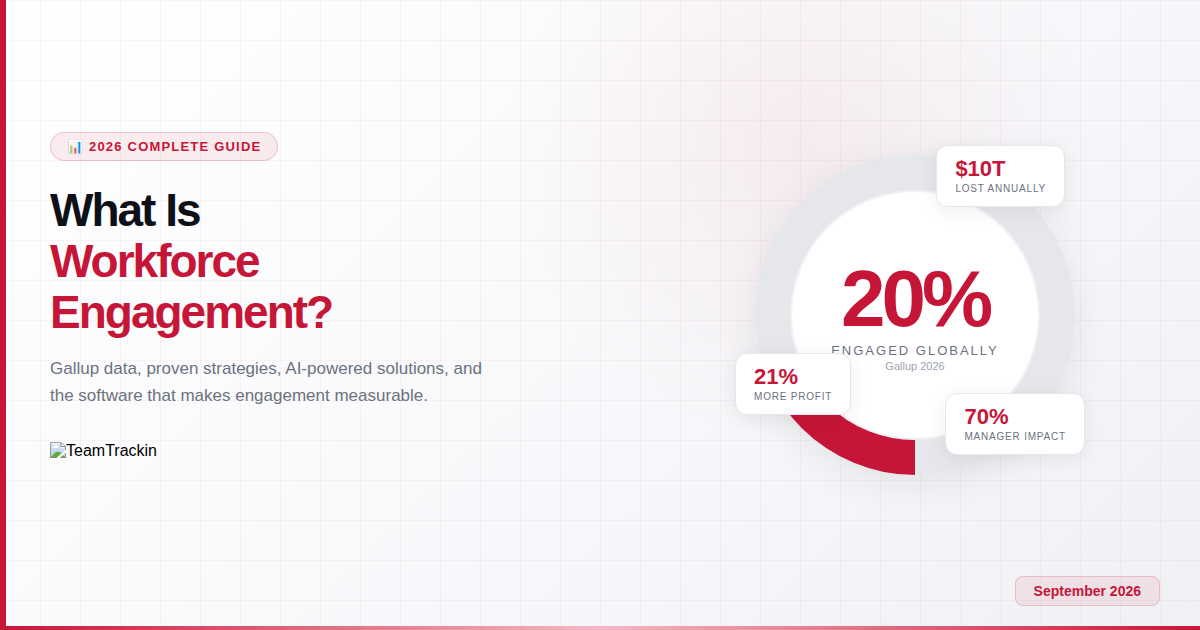
Global workforce engagement has dropped to a five-year low — only 20% of employees worldwide feel engaged at work. That's costing the global economy $10 trillion every year. This guide breaks down what workforce engagement actually means, why it's declining, proven strategies to improve it (including AI), and the software that makes it measurable.
Workforce engagement is the degree to which employees feel emotionally committed, motivated, and connected to their work and their organisation. An engaged workforce doesn't just show up — they bring discretionary effort, take ownership of outcomes, and align their personal goals with business objectives.
Workforce engagement management (WEM) is the strategy and software category that combines workforce planning, performance analytics, quality monitoring, and employee feedback into a unified system — giving organisations the tools to measure, manage, and improve engagement at scale.
What Is Workforce Engagement? (The Full Picture)
Workforce engagement goes beyond job satisfaction. A satisfied employee might be content enough not to leave, but an engaged employee is actively invested in their work and the organisation's success. The distinction matters because satisfaction maintains the status quo while engagement drives growth.
Gallup — the global authority on engagement research — defines engaged employees as those who are "involved in, enthusiastic about, and committed to their work and workplace." They segment the global workforce into three categories:
Engaged (20% globally)
Highly involved, enthusiastic about their work, feel a sense of ownership. They drive innovation, go beyond minimum requirements, and positively influence their colleagues. These are your organisation's force multipliers.
Not Engaged (62% globally)
Psychologically unattached to their work. They show up, do the minimum, and watch the clock. They're not actively hostile — just disengaged. This is the "quiet quitting" population, and it's by far the largest segment.
Actively Disengaged (18% globally)
Unhappy and unproductive — and they spread that negativity to others. Actively disengaged employees undermine the work of their engaged colleagues, damage morale, and are the most likely to leave (or worse, stay and poison the culture).
This means for every engaged employee on your team, approximately three others are either checked out or actively working against your organisation's interests. The math is stark: in a team of 10, two people are driving results while eight are coasting or dragging.
The terms are often used interchangeably, but there's a subtle difference. Employee engagement focuses on the individual's relationship with their work. Workforce engagement is the broader organisational lens — it includes the systems, strategies, tools, and management practices that create the conditions for engagement across the entire workforce. Think of employee engagement as the outcome and workforce engagement as the system that produces it.
Why Global Workforce Engagement Is Declining
Global workforce engagement fell to 20% in 2025 — down from a peak of 23% in 2022. In the United States, engagement dropped to 31%, the lowest in a decade. This isn't a blip; it's a trend with identifiable causes. Gallup's research points to several converging factors:
The manager crisis
Managers are the single most important variable in workforce engagement — they account for 70% of the variance in team engagement scores. And manager engagement itself is collapsing. Global manager engagement fell to 22% in the latest reading, down from 30% just two years prior. Managers under 35 saw one of the sharpest declines, dropping roughly five percentage points in a single year. Female manager engagement fell by seven points. When managers are disengaged, the teams they lead have virtually no chance of being engaged.
Post-pandemic workforce disruption
The rapid restructuring that followed the pandemic — high turnover, return-to-office mandates, layoffs, and constant policy reversals — eroded the trust and stability that engagement requires. Employees who survived multiple rounds of restructuring report lower engagement than those who experienced none, even when their own job security was never directly threatened.
Workload without support
Roughly 35% of global employees feel overwhelmed at least once a week, rising to 42% for Gen Z workers. Meanwhile, 68% say they don't have enough uninterrupted time to focus on their most important tasks. The combination of increasing workloads with decreasing focus time creates a burnout-engagement death spiral: people work harder but accomplish less, which makes them feel worse about their work, which further reduces engagement.
The disconnect between executives and employees
A 2026 People Element report found that 76% of executives are excited about AI's potential in the workplace — but the employees actually affected by AI share far less enthusiasm. This pattern — leaders prioritising strategy while employees experience the consequences — extends beyond AI to restructuring, culture initiatives, and performance management. When people feel things are done to them rather than with them, engagement evaporates.
The engagement decline has one primary driver: managers. Fix the manager experience — give them clarity, tools, training, and manageable workloads — and you move the entire team. Every dollar spent on manager development has a multiplier effect that no other engagement investment matches.
The Business Case: What an Engaged Workforce Actually Delivers
Workforce engagement isn't a "nice to have" — it's a business performance metric that shows up directly in financial results. Gallup's meta-analysis of business units across dozens of industries consistently shows that teams in the top quartile of engagement outperform bottom-quartile teams on every measurable outcome:
| Business Outcome | Impact of High Engagement |
|---|---|
| Profitability | 21% higher in top-quartile engaged teams |
| Productivity | 17% higher output per employee |
| Employee turnover | Up to 51% lower in high-engagement organisations |
| Absenteeism | 78% lower in engaged teams |
| Customer satisfaction | 10% higher ratings from engaged employee interactions |
| Quality (defects/errors) | 37% fewer errors and 49% fewer safety incidents |
| Discretionary effort | 57% improvement in extra effort beyond minimum requirements |
| Individual performance | 20% improvement per engaged employee |
The cost of getting this wrong is equally dramatic. Low engagement costs the global economy approximately $10 trillion per year in lost productivity — roughly 9% of global GDP. For a 1,000-person organisation with average engagement levels, the annual cost of disengagement is estimated at $2.4 million in lost productivity alone, before accounting for turnover, quality issues, and customer impact.
The ROI framing: A disengaged employee earning $60,000 per year produces roughly 18% less output — that's $10,800 in lost value per person, per year. Replacing an employee who leaves due to disengagement costs 50-200% of their annual salary. For a mid-level skilled role, that's $30,000 to $120,000 per departure. Engagement isn't an HR cost — it's an operating efficiency multiplier.
Make engagement visible. Make it measurable.
TeamTrackin gives you real-time productivity data, project tracking, and workforce analytics.
How to Measure Workforce Engagement
You can't improve what you don't measure. Workforce engagement is assessed through two complementary approaches — survey-based and behavioural — and the most effective organisations use both.
Survey-based measurement
Annual engagement surveys (like Gallup's Q12), quarterly pulse surveys, and targeted feedback tools capture how employees feel. They measure psychological commitment, satisfaction, and perceived support. Limitation: they capture a snapshot in time and depend on honest responses.
Behavioural measurement
Productivity data, active vs idle time, attendance patterns, voluntary turnover rates, and participation in optional activities capture how engagement manifests in behaviour. Time tracking and activity monitoring tools provide continuous, objective data between survey cycles.
Combined approach
Surveys tell you why people feel the way they do. Behavioural data tells you what's actually happening. Together, they provide a complete picture: are employees who report feeling engaged actually more productive? Are teams with low survey scores showing higher turnover? The combination is where actionable insights live.
Key metrics to track
- eNPS (Employee Net Promoter Score): Would employees recommend your organisation as a place to work? Scored on a 0-10 scale and benchmarked over time.
- Voluntary turnover rate: The percentage of employees who leave by choice. High voluntary turnover is the ultimate signal of low engagement.
- Absenteeism rate: Frequent unplanned absences correlate strongly with disengagement. Engaged employees miss fewer days.
- Productivity scores: Active time vs idle time, tasks completed, and project velocity — measured through time tracking and project management tools.
- Participation rates: Engagement in optional meetings, training programmes, social events, and feedback surveys. Low participation signals low investment.
8 Proven Strategies to Improve Workforce Engagement
Engagement doesn't improve through a single annual survey and a generic "action plan." It requires sustained, systemic changes to how work is structured, managed, and experienced. Here are eight strategies backed by research and real-world results:
1. Invest in manager development (the #1 lever)
Managers account for 70% of engagement variance. Yet most managers are promoted for individual performance, not people skills, and receive minimal training on coaching, feedback, or team development. The highest-impact engagement investment any organisation can make is structured manager training focused on regular one-on-ones, effective feedback, recognition, and clear goal-setting. Gallup's data shows that when manager engagement improves, team engagement follows proportionally.
2. Create clarity around expectations and goals
One of the most consistent findings in engagement research is that employees who understand exactly what's expected of them are significantly more engaged. This sounds obvious, but a surprising number of employees report unclear priorities, shifting goals, and conflicting direction from different leaders. Clear, measurable objectives — tied to projects, deadlines, and outcomes — give people a framework for meaningful contribution.
3. Build a culture of recognition
Recognition is one of the highest-leverage, lowest-cost engagement tools available — yet most organisations under-invest in it dramatically. Employees who feel recognised are significantly less likely to leave and more likely to go beyond minimum requirements. Recognition doesn't require expensive programmes; it requires consistency, specificity ("thank you for staying late to fix the client report" vs generic "good job"), and visibility. Gen Z workers in particular expect frequent, social recognition — not annual awards.
4. Give employees autonomy and ownership
Micromanagement is the enemy of engagement. When employees have autonomy over how they accomplish their work — even if the what and when are defined — their sense of ownership and investment increases substantially. This is especially important for remote and hybrid teams, where trust-based management outperforms surveillance-based approaches in every engagement metric.
5. Provide growth and development pathways
Lack of career development is one of the top three reasons employees leave organisations. Engaged workforces have clear pathways for growth — not just promotions, but skill development, lateral moves, mentorship, and meaningful project assignments. When employees see a future at the organisation, they invest in the present.
6. Prioritise work-life balance and prevent burnout
With 35% of employees feeling overwhelmed weekly, burnout prevention is an engagement strategy. This means realistic workloads, proper leave management, respect for off-hours boundaries, and monitoring for early warning signs — such as consistently high overtime or declining productivity scores — that indicate employees are approaching burnout.
7. Make feedback continuous, not annual
Annual performance reviews are too infrequent to drive engagement. By the time feedback arrives, the relevant context is months old. Organisations with high engagement use continuous feedback loops: weekly one-on-ones, monthly check-ins, real-time recognition, and regular pulse surveys. The goal is making feedback a normal part of work rather than a dreaded annual event.
8. Use data to identify and act on disengagement early
By the time an employee resigns, their disengagement is months old. Workforce analytics — productivity trends, attendance patterns, project participation, and survey data — can surface warning signs early enough to intervene. Time tracking and activity monitoring tools provide objective, continuous data that complements the subjective, periodic data from surveys. When productivity drops, idle time increases, or overtime spikes, those are behavioural signals of disengagement that deserve attention.
Every proven engagement strategy shares one element: visibility. Visible expectations, visible recognition, visible growth paths, visible workload data, visible feedback. Engagement thrives in transparency and withers in ambiguity. The role of workforce engagement software is to create that visibility at scale.
How Companies Can Improve Workforce Engagement with AI
AI is rapidly transforming workforce engagement management — not by replacing human connection, but by making engagement efforts more precise, personalised, and proactive. Here's how organisations are using AI to move the engagement needle in 2026:
Predictive analytics for disengagement
AI analyses patterns in productivity data, attendance, survey responses, and communication to identify employees at risk of disengagement or departure — weeks before a resignation letter appears. This shifts engagement from reactive to proactive.
Intelligent workload balancing
AI monitors hours worked, task distribution, and overtime patterns to flag burnout risk and recommend workload redistribution. Instead of waiting for employees to report overwhelm, the system identifies imbalances automatically.
Personalised learning recommendations
AI matches employees with relevant training, mentorship, and development opportunities based on their role, skills, performance data, and career goals — making growth pathways feel personalised rather than generic.
Sentiment analysis on feedback
AI processes open-ended survey responses, communication patterns, and feedback data to detect sentiment shifts — surfacing themes and concerns that manual review would miss, especially in large organisations.
Optimised scheduling
AI-powered scheduling considers employee preferences, workload capacity, and historical productivity patterns to create schedules that maximise both operational efficiency and employee satisfaction.
Automation of low-value tasks
AI handles repetitive administrative work — timesheet approvals, report generation, routine communications — freeing employees to focus on the meaningful, complex work that drives engagement. When people spend less time on busywork, they have more capacity for impactful contributions.
The AI engagement paradox: While 76% of executives are excited about AI, employee enthusiasm is notably lower. The organisations getting AI right for engagement are those that use AI to empower employees (better tools, less busywork, smarter scheduling) rather than monitor them (surveillance-first approaches that destroy the trust engagement requires). The framing matters as much as the technology.
What Is Workforce Engagement Management Software?
Workforce engagement management (WEM) software is a category of platforms that combines workforce planning, performance analytics, quality monitoring, employee feedback, and engagement tools into a unified system. Originally developed for contact centres, WEM has expanded to cover any organisation that needs to manage and improve engagement at scale.
Modern WEM platforms typically include these core capabilities:
- Workforce management: Forecasting demand, scheduling staff, and managing time and attendance to ensure the right people are available at the right times without creating burnout through overscheduling.
- Performance analytics: Tracking individual and team productivity, identifying trends, and providing managers with data-driven insights for coaching conversations.
- Quality monitoring: Evaluating work quality through automated and manual reviews, ensuring standards are met and improvement areas are identified.
- Employee feedback: Pulse surveys, recognition tools, and communication channels that give employees a voice and give leaders visibility into sentiment.
- Coaching and development: Tools for managers to deliver targeted feedback, assign training, and track development progress — closing the loop between performance data and growth action.
- AI and automation: Intelligent features that automate routine decisions, predict outcomes, and surface insights that would be invisible in manual processes.
Major players in the WEM space include NICE, Verint, Calabrio, Genesys, and more recently, Microsoft (with WEM in Dynamics 365) and Cisco (with Webex WEM). For organisations outside the contact centre space — particularly remote and hybrid teams — platforms like TeamTrackin provide workforce engagement capabilities through time tracking, productivity monitoring, project management, and workforce analytics.
How TeamTrackin Supports Workforce Engagement
TeamTrackin is built for remote and hybrid teams that need visibility into how work happens — the foundation that all workforce engagement efforts depend on. When you can see where time goes, how projects progress, and where productivity bottlenecks exist, you have the data to make engagement-driving decisions instead of relying on guesswork.
Automatic time tracking
See exactly how hours are spent across the workforce — by employee, team, project, and client. Identify workload imbalances before they become burnout.
Productivity monitoring
Activity scores, active vs idle time, and productivity timelines give managers objective data for coaching — replacing micromanagement with measurement.
Project management
Kanban boards, sprints, milestones, and Gantt charts create the clear expectations and visible progress that engagement requires. Everyone knows what they're working on and why.
Payroll & fair compensation
Tracked hours flow directly into payroll — ensuring employees are paid accurately for every hour worked. Fair, transparent compensation is a baseline engagement requirement.
Leave & overtime management
Monitor overtime trends, manage leave requests, and ensure workload distribution prevents burnout — the engagement killer that data makes preventable.
Workforce analytics
Reports and dashboards surface workforce trends — productivity changes, attendance patterns, project velocity — that serve as behavioural engagement indicators between formal surveys.
Frequently Asked Questions
- What is workforce engagement?
Workforce engagement is the degree to which employees feel emotionally committed, motivated, and connected to their work and their organisation. An engaged workforce doesn't just show up — they bring discretionary effort, take ownership of outcomes, and align their personal goals with business objectives. It's measured through surveys, productivity data, turnover rates, and behavioural signals like active versus idle time.
- What is workforce engagement management?
Workforce engagement management (WEM) is a category of software and strategy that combines workforce management (scheduling, forecasting), quality monitoring, performance analytics, coaching tools, and employee feedback into a unified system. Originally developed for contact centres, WEM has expanded to cover any organisation that needs to optimise both operational efficiency and employee engagement simultaneously.
- What is an engaged workforce?
An engaged workforce is one where employees are psychologically invested in their work, consistently go beyond minimum requirements, feel a sense of purpose and belonging, and actively contribute to the organisation's success. Gallup classifies engaged employees as those who are involved in, enthusiastic about, and committed to their work. Engaged workforces show 21% higher profitability, 17% higher productivity, and up to 51% lower turnover than disengaged teams.
- How can companies improve workforce engagement with AI?
Companies can improve workforce engagement with AI by using predictive analytics to identify disengagement patterns early, automating routine tasks so employees focus on meaningful work, delivering personalised learning recommendations, using sentiment analysis on surveys and communications, optimising scheduling to reduce burnout, and providing real-time feedback. The key is using AI to enhance the employee experience — not to create surveillance.
- How do you measure workforce engagement?
Workforce engagement is measured through survey-based approaches (annual engagement surveys, pulse surveys, Gallup's Q12) and behavioural methods (productivity scores, active vs idle time, attendance patterns, turnover rates). The most effective approach combines both — surveys reveal how employees feel, while behavioural data shows how those feelings translate into actual work patterns.
- Why is workforce engagement declining globally?
Global engagement fell to 20% in 2025, driven by declining manager engagement (fell to 22% globally), post-pandemic workforce disruption, increased workloads without support, poor communication from leadership, and the disconnect between executive priorities and employee experience. Gallup identifies the manager as the single biggest lever — managers account for 70% of the variance in team engagement scores.
External sources: Engagement statistics and research cited in this article are sourced from Gallup's State of the Global Workplace reports (2025/2026). All data was verified as of September 2026.
Build an engaged workforce.
Start with visibility.
TeamTrackin gives you the productivity data, project visibility, and workforce analytics that engagement strategies depend on — all in one platform.
Start Free Trial→14-day free trial · No credit card · Setup in ~3 minutes