
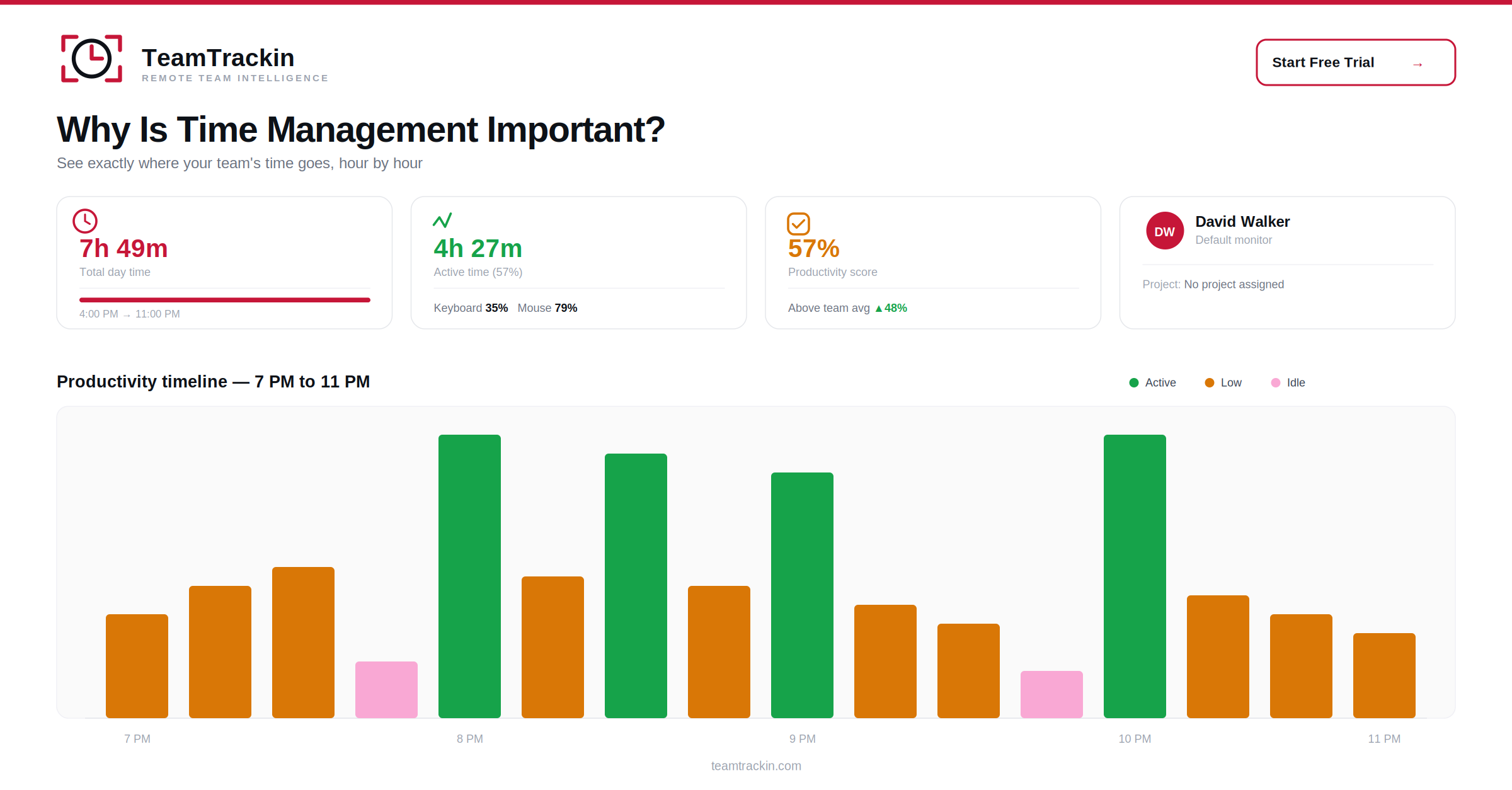
The average employee is genuinely productive for just 2 hours and 53 minutes of an 8-hour day. The rest gets absorbed by low-value tasks, meetings, and interruptions — and it costs businesses real money. Here's what good time management actually changes at work, and how TeamTrackin helps teams see where their time is really going.
Time management is important because it determines how much of the workday actually produces value. The average employee is genuinely productive for only about 2 hours and 53 minutes of an 8-hour day — the rest goes to low-value tasks and interruptions. Good time management, at both the individual level and the team level, closes that gap — improving output and reducing stress without requiring longer hours.
For a broader look at time management as a personal skill, see our guide on the importance of time management. This article focuses specifically on what it means for teams and workplaces.
Why Is Time Management Important? The Short Answer
Time is the one resource every employee and every business has in exactly equal, non-renewable supply — 24 hours a day, no exceptions. What separates a productive team from a struggling one usually isn't talent or effort. It's how deliberately that fixed amount of time gets allocated.
Without a system, work defaults to whatever feels most urgent in the moment — which is rarely the same as what's actually important. That's how reactive, unmanaged workdays quietly produce the 51% figure above: not from anyone slacking off, but from a full day of effort with no structure directing where that effort goes.
Time management is important because it determines how much of a limited, non-renewable resource — time — actually goes toward valuable work. Without it, effort still happens, but it gets absorbed by low-value tasks and reactive work instead of producing meaningful output.
What Poor Time Management Actually Costs a Business
This isn't an abstract productivity concept — it shows up as a real line item. Workplace distractions alone are estimated to cost US businesses $588 billion a year. At the individual level, 35% of employees name time management as their single biggest obstacle to getting work done, ahead of most other factors researchers measure.
It also shows up in ways that don't appear on a balance sheet directly: burnout, missed deadlines, and turnover. Poor time management is closely linked to workplace stress — 91% of employees say better time management would reduce theirs, which is a strong signal about where a meaningful share of everyday workplace stress actually originates.
A single person's disorganized day is a personal inefficiency. A team's disorganized week becomes missed handoffs, rescheduled meetings, and deadlines that slip sideways onto everyone downstream — time management problems compound across distributed teams faster than in a single-person workflow.
6 Ways Good Time Management Improves a Workplace
These aren't abstract benefits — each one shows up in measurable ways once a team adopts real time-management practices.
Simple frameworks help here more than complex ones. The 1-3-5 rule and similar structured techniques tend to stick better than ambitious systems that collapse under a busy week.
Individual Time Management vs Team Time Management
These are related but genuinely different problems, and conflating them is a common reason time management initiatives underperform.
- Prioritizing your own task list
- Blocking focus time on your own calendar
- Avoiding multitasking and context switching
- Managing your own energy and attention
- Clear handoffs between people and roles
- Realistic, shared deadlines
- Visibility into who's carrying what workload
- Meeting discipline that protects everyone's time
A team can be full of excellent individual time managers and still struggle if the team-level system is missing — which is why improving team productivity usually requires shared visibility tools, not just individual willpower. Measuring this properly often comes down to a clear employee productivity formula the whole team understands.
See where your team's time actually goes.
TeamTrackin turns time management from guesswork into data — try it free.
Common Time Management Mistakes That Hurt Teams
A few patterns show up repeatedly in teams that struggle with time management, and most are fixable without any new tools:
- Treating every request as urgent — when everything is a priority, nothing actually is.
- Meeting-first culture — defaulting to a meeting instead of an async update eats focus time fast.
- No visibility into real workload — deadlines get set without knowing who already has too much on their plate.
- Multitasking as a badge of honor — it feels productive and measurably isn't.
For a deeper breakdown of these patterns, see our guide on time management mistakes that hurt productivity. Frameworks like time blocking vs time boxing can help fix several of these at once by giving structure to how the day is actually planned.
How to Build a Time-Management Culture on Your Team
Individual tips help, but a real shift happens when time management becomes part of how the team operates, not just a personal habit a few people adopt.
- Make workload visible. If managers can't see who's overloaded, deadlines get set on hope instead of data.
- Protect focus blocks company-wide. A shared no-meeting window does more than individual willpower ever will.
- Review, don't just plan. A quick weekly look at what actually happened vs what was planned catches drift early.
- Use a real time management app — one shared system beats everyone using a different personal method.
How TeamTrackin Supports Better Time Management
Most time management advice assumes you already know where your time goes. In practice, most teams don't — which is why accurate time tracking is usually the missing first step, not an afterthought.
Frequently Asked Questions
- Why is time management important?
Time management is important because it directly determines how much of the workday actually produces value. Research shows the average employee is genuinely productive for only about 2 hours and 53 minutes of an 8-hour day, with over half the day going to low-value tasks. Good time management closes that gap — improving output, reducing stress, and protecting deadlines without requiring longer hours.
- Why is time management important in the workplace specifically?
In the workplace, poor time management doesn't just affect one person's day — it compounds across a whole team through missed deadlines, last-minute handoffs, and meetings scheduled to fix problems that better planning would have prevented. At scale, this is measurable: workplace distractions alone cost US businesses an estimated $588 billion a year.
- What's the difference between individual and team time management?
Individual time management is about how one person plans and protects their own hours — prioritizing tasks, blocking focus time, avoiding multitasking. Team time management is about how work moves between people: clear handoffs, realistic deadlines, and shared visibility into who's doing what. A team can have excellent individual time managers and still function poorly if the team-level system is missing.
- Can better time management actually reduce stress at work?
Yes — 91% of employees say improved time management would lower their stress at work, and 73% associate it with better work-life balance. Much of workplace stress comes from feeling behind or blindsided by deadlines, both of which structured time management directly addresses.
- How does TeamTrackin help with time management at work?
TeamTrackin gives teams visibility into where time actually goes — by task, project, and person — so time management decisions are based on real data instead of guesswork, plus reporting that helps managers spot overloaded schedules before they become missed deadlines.
Stop guessing where
your team's time goes.
TeamTrackin gives you real visibility into time, tasks, and workload — try it free for 14 days.
Start Free Trial→