
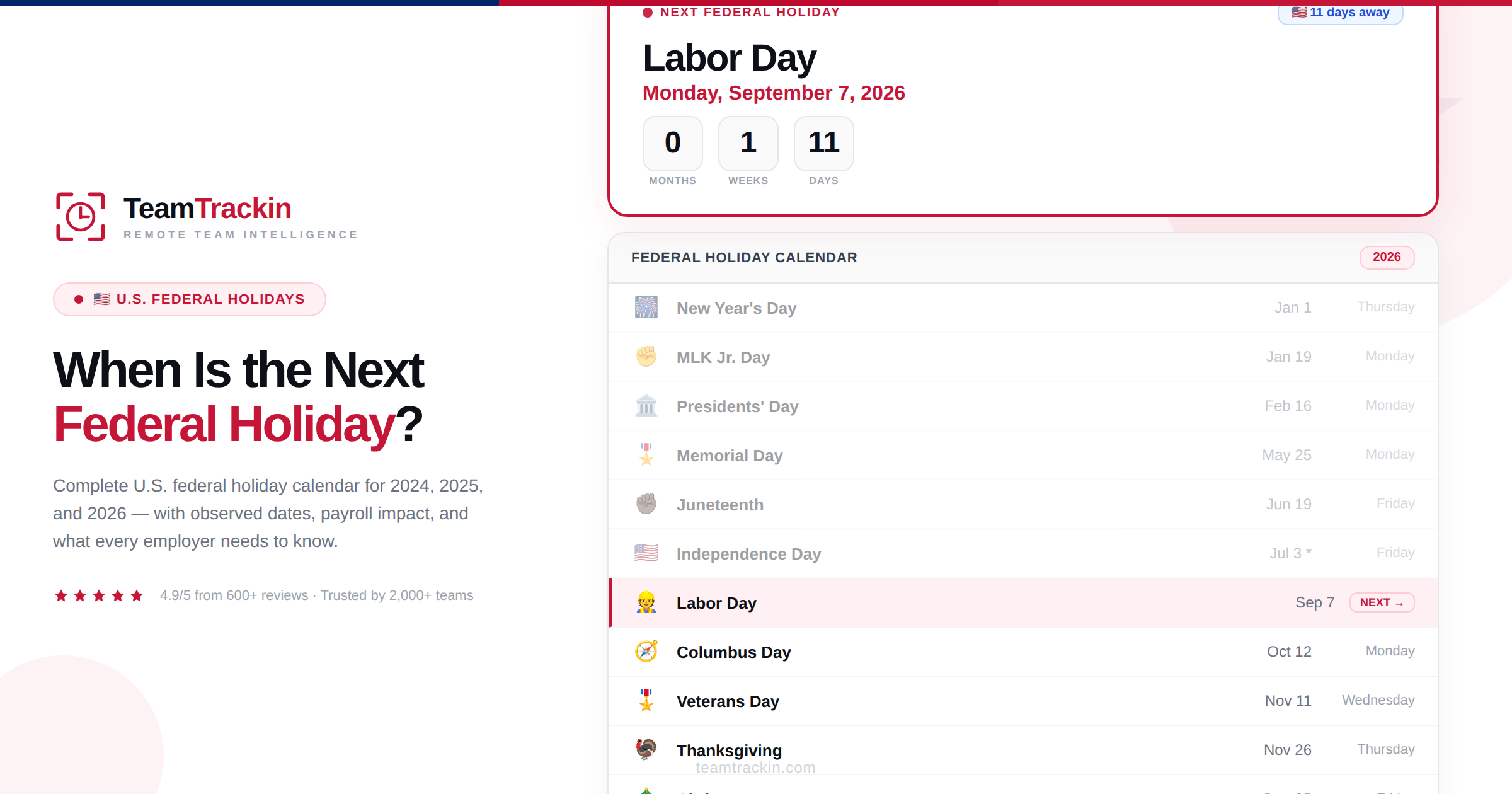
The next federal holiday is Labor Day — Monday, September 7, 2026. There are 11 federal holidays in America each year, established by federal law. Here's the complete calendar for 2026, 2025, and 2024 — with observed dates, what closes, who gets the day off, and how holidays affect payroll and time tracking.
The next federal holiday is Labor Day — Monday, September 7, 2026. As of August 27, 2026, Labor Day is 11 days away. It is observed on the first Monday of September each year and honors the contributions of American workers. All federal government offices, banks, post offices, and financial markets will be closed.
There are 11 federal holidays in the United States each year, established by Congress under 5 U.S.C. § 6103. The most recent addition was Juneteenth National Independence Day, signed into law on June 17, 2021. When a federal holiday falls on a Saturday, the observed holiday shifts to the preceding Friday; when it falls on a Sunday, it shifts to the following Monday.
When Is the Next Federal Holiday?
As of today — August 27, 2026 — the next federal holiday is Labor Day, observed on Monday, September 7, 2026. It falls 11 days from now.
Labor Day is observed on the first Monday of September every year. It was established as a federal holiday in 1894 and honors the American labor movement and the contributions workers have made to the country's strength, prosperity, and well-being. For most Americans, Labor Day also marks the unofficial end of summer and the beginning of the back-to-school season.
On Labor Day, all federal government offices are closed. The U.S. Postal Service does not deliver mail. Banks, financial markets, and the Federal Reserve are closed. Most schools are closed. Many private employers give the day off as a paid holiday, though they are not legally required to do so.
Remaining federal holidays in 2026
After Labor Day, there are four more federal holidays left in 2026:
| Holiday | Date | Day | Days Away |
|---|---|---|---|
| Labor Day | September 7 | Monday | 11 days |
| Columbus Day | October 12 | Monday | 46 days |
| Veterans Day | November 11 | Wednesday | 76 days |
| Thanksgiving Day | November 26 | Thursday | 91 days |
| Christmas Day | December 25 | Friday | 120 days |
All Federal Holidays in 2026 — Complete Calendar
The United States has 11 federal holidays in 2026. In 2026, Independence Day (July 4) falls on a Saturday, so the observed federal holiday is Friday, July 3. All other holidays fall on weekdays and are observed on their calendar dates.
| # | Holiday | Date | Day | Observed |
|---|---|---|---|---|
| 1 | New Year's Day | January 1 | Thursday | January 1 |
| 2 | Martin Luther King Jr. Day | January 19 | Monday | January 19 |
| 3 | Presidents' Day (Washington's Birthday) | February 16 | Monday | February 16 |
| 4 | Memorial Day | May 25 | Monday | May 25 |
| 5 | Juneteenth National Independence Day | June 19 | Friday | June 19 |
| 6 | Independence Day | July 4 | Saturday | Friday, July 3 * |
| 7 | Labor Day | September 7 | Monday | September 7 |
| 8 | Columbus Day / Indigenous Peoples' Day | October 12 | Monday | October 12 |
| 9 | Veterans Day | November 11 | Wednesday | November 11 |
| 10 | Thanksgiving Day | November 26 | Thursday | November 26 |
| 11 | Christmas Day | December 25 | Friday | December 25 |
* Independence Day falls on Saturday, July 4. The federal observed holiday is the preceding Friday, July 3, 2026.
In 2026, March, April, and August are the only months without a federal holiday. For a breakdown of how many actual working days remain after holidays and weekends, see our guide on how many work days are in a year.
Federal Holidays 2025 (Reference)
| # | Holiday | Date | Day |
|---|---|---|---|
| 1 | New Year's Day | January 1 | Wednesday |
| 2 | Martin Luther King Jr. Day | January 20 | Monday |
| 3 | Presidents' Day | February 17 | Monday |
| 4 | Memorial Day | May 26 | Monday |
| 5 | Juneteenth | June 19 | Thursday |
| 6 | Independence Day | July 4 | Friday |
| 7 | Labor Day | September 1 | Monday |
| 8 | Columbus Day | October 13 | Monday |
| 9 | Veterans Day | November 11 | Tuesday |
| 10 | Thanksgiving Day | November 27 | Thursday |
| 11 | Christmas Day | December 25 | Thursday |
Legal Holidays 2024 (Reference)
For historical reference, compliance records, and payroll archives, here is the complete list of legal holidays in 2024. These are the same 11 federal holidays established under 5 U.S.C. § 6103.
| # | Holiday | Date | Day |
|---|---|---|---|
| 1 | New Year's Day | January 1 | Monday |
| 2 | Martin Luther King Jr. Day | January 15 | Monday |
| 3 | Presidents' Day | February 19 | Monday |
| 4 | Memorial Day | May 27 | Monday |
| 5 | Juneteenth | June 19 | Wednesday |
| 6 | Independence Day | July 4 | Thursday |
| 7 | Labor Day | September 2 | Monday |
| 8 | Columbus Day | October 14 | Monday |
| 9 | Veterans Day | November 11 | Monday |
| 10 | Thanksgiving Day | November 28 | Thursday |
| 11 | Christmas Day | December 25 | Wednesday |
What Are Federal Holidays in America?
Federal holidays in America are days designated by the United States Congress under federal law (5 U.S.C. § 6103) on which federal government offices are closed and federal employees receive paid leave. There are currently 11 federal holidays per year — a number that has not changed since June 2021, when Juneteenth was added as the newest federal holiday.
The holidays in America that carry federal status are not chosen arbitrarily. Each one falls into one of three categories: holidays honoring significant national events (Independence Day, Thanksgiving, Christmas, New Year's), holidays honoring the service of specific groups (Veterans Day, Memorial Day, Labor Day), and holidays honoring individuals who shaped American history (Martin Luther King Jr. Day, Washington's Birthday, Columbus Day/Indigenous Peoples' Day, Juneteenth).
What closes on federal holidays?
- Federal government offices — all executive branch departments, Social Security offices, passport agencies, federal courts.
- U.S. Postal Service — no regular mail delivery on any federal holiday.
- Banks — most branches close on all 11 federal holidays (governed by the Federal Reserve schedule).
- Financial markets — the NYSE and NASDAQ close on federal holidays (with some exceptions for shortened trading days).
- Many schools — most public school districts observe federal holidays, though the specific calendar varies by district and state.
Retail stores, restaurants, and private businesses are not required to close on federal holidays. Many choose to remain open, especially on holidays with high consumer activity like Memorial Day, Labor Day, and the days surrounding Thanksgiving and Christmas.
Each state may designate additional holidays beyond the 11 federal ones. For example, many states observe the day after Thanksgiving as a state holiday. Some states observe Cesar Chavez Day, Patriot's Day, or Election Day. State holidays vary significantly — a day that is a paid holiday for state employees in Texas may not be recognized in New York. Federal holidays are the only ones that are uniform nationwide.
Federal Holiday vs National Holiday — What's the Difference?
In everyday conversation, "federal holiday" and "national holiday" are used interchangeably — but they have different technical meanings, and understanding the distinction matters for businesses managing paid time off policies.
The United States does not technically have "national holidays" in the legal sense. What it has are federal holidays — days established by Congress that apply specifically to federal government operations and federal employees. The President and Congress do not have the authority to declare a binding holiday for all citizens or all employers.
When people refer to a "national holiday" or search for the "next national holiday," they are almost always referring to one of the 11 federal holidays — since these are the holidays that are most widely recognized and observed across the country. The term "national holiday" is a colloquial shorthand, not a legal classification.
| Term | What it means | Legal status |
|---|---|---|
| Federal holiday | Established by Congress; federal offices close, federal employees get paid leave | Legally binding for federal govt |
| National holiday | Informal term — usually refers to federal holidays | Not a legal classification in the US |
| State holiday | Designated by individual states; varies by state | Legally binding for state govt employees |
| Public holiday | General term for any widely observed holiday | No specific legal status |
Track holidays, PTO, and working hours in one place.
TeamTrackin handles holiday calendars, leave tracking, and payroll — automatically.
Do Employers Have to Give Federal Holidays Off?
No — private employers are not required by federal law to give employees time off or extra pay on federal holidays. Federal holidays legally apply only to federal government operations and federal employees. Whether a private company observes a holiday, and how they compensate employees who work on one, is entirely at the employer's discretion.
That said, the vast majority of US employers do offer some paid holidays. According to the Bureau of Labor Statistics, about 79% of private industry workers receive paid holidays as part of their benefits package, with an average of 8 paid holidays per year. The most commonly observed holidays by private employers are Thanksgiving, Christmas, New Year's Day, Memorial Day, Independence Day, and Labor Day.
Holiday pay for hourly employees
There is a common misconception that employees who work on federal holidays are entitled to "time and a half" or double pay. Under the Fair Labor Standards Act (FLSA), there is no federal requirement for premium pay on holidays — holiday work is treated the same as any other workday for overtime purposes. Some states have their own holiday pay rules, and many employers offer premium rates voluntarily, but this is not a federal mandate.
For exempt employees, the calculation is different — salaried exempt employees typically receive their regular salary regardless of whether they work on a holiday or not. What changes is whether they are given a compensatory day off, which is a company policy decision.
⚠️ For agencies and remote teams: If your team includes employees across multiple states, you need to check each state's specific holiday pay requirements. Some states (like Massachusetts and Rhode Island) have "blue laws" that may require premium pay for retail workers on certain holidays. Managing this across distributed teams is where leave management software becomes essential.
How Federal Holidays Affect Payroll and Time Tracking
Federal holidays create several operational challenges for payroll teams and managers — especially at agencies, remote-first companies, and hybrid organizations where not everyone follows the same holiday schedule.
Working hours and workday calculations
In a standard year, there are 365 days, of which 261 are weekdays. Subtracting the 11 federal holidays that fall on weekdays leaves approximately 250 actual working days — though the exact number varies year to year depending on which days holidays land on. For 2026, with Independence Day's observed holiday shifting from Saturday to Friday, there are 250 working days after subtracting all 11 holidays. For detailed calculations, see our guide on how many work days are in a year.
Timesheet implications
When a holiday falls in the middle of a pay period, timesheets need to accurately reflect: which employees were given the day off (paid holiday hours), which employees worked the holiday (regular or premium hours), and how the holiday affects overtime calculations for that workweek. Manual timesheet systems handle this poorly because they depend on employees correctly categorizing holiday hours.
Overtime and holiday week calculations
A common question: if an employee works 40 hours in a week that includes a paid holiday, do the 8 holiday hours count toward overtime? The federal answer is no — the FLSA only counts hours actually worked toward the 40-hour overtime threshold. Paid holiday hours are not hours worked. However, some companies' internal policies and some union contracts do count holiday hours toward overtime — so the answer depends on the specific employer's policy.
For remote teams and agencies with employees across multiple states or countries, the holiday problem compounds: different employees may observe different holidays, some may work while others are off, and pay rules vary by location. Without centralized time tracking that accounts for per-employee holiday calendars, payroll errors on holiday weeks are almost inevitable.
How TeamTrackin Handles Holiday and Leave Tracking
TeamTrackin includes built-in holiday management that integrates directly with time tracking, timesheets, and payroll — so holidays are handled automatically rather than manually adjusted after the fact.
Built-in holiday calendars
Pre-loaded US federal holiday calendar. Customize which holidays your company observes, add company-specific days off, and set different calendars for different teams or locations.
Automatic PTO integration
Holiday hours are automatically reflected in timesheets and leave balances. No manual entry — employees see the holiday on their calendar, and their timesheet reflects paid holiday hours without them needing to do anything.
Holiday-aware overtime
The system distinguishes between actual hours worked and paid holiday hours when calculating overtime — ensuring compliance with FLSA rules while respecting any company-specific policies about holiday overtime.
Multi-location support
Assign different holiday calendars to different teams, departments, or locations. Your US team sees US federal holidays. Your UK team sees UK bank holidays. Payroll stays accurate for everyone.
Payroll-ready exports
Timesheets export with holiday hours clearly separated — regular hours, holiday hours, overtime hours, PTO — formatted for direct import to your payroll system.
Workforce analytics
See how holidays affect your team's productive hours, project timelines, and capacity. Plan around holiday weeks with data rather than guesswork.
Frequently Asked Questions
- When is the next federal holiday?
As of August 27, 2026, the next federal holiday is Labor Day — Monday, September 7, 2026. Labor Day is observed on the first Monday of September each year and honors the contributions of American workers. All federal government offices, banks, post offices, and financial markets will be closed.
- How many federal holidays are there in the United States?
There are 11 federal holidays in the United States, established by Congress under 5 U.S.C. § 6103. The most recent addition was Juneteenth National Independence Day, signed into law on June 17, 2021.
- What were the legal holidays in 2024?
The 11 legal (federal) holidays in 2024 were: New Year's Day (Jan 1), MLK Day (Jan 15), Presidents' Day (Feb 19), Memorial Day (May 27), Juneteenth (Jun 19), Independence Day (Jul 4), Labor Day (Sep 2), Columbus Day (Oct 14), Veterans Day (Nov 11), Thanksgiving (Nov 28), and Christmas Day (Dec 25).
- Do private employers have to give federal holidays off?
No. Federal holidays only legally require federal government offices to close. Private employers are not required by federal law to give time off or extra pay on federal holidays. However, about 79% of private employers offer paid holidays as part of their benefits, with an average of 8 paid holidays per year.
- What is the difference between a federal holiday and a national holiday?
The US does not technically have "national holidays" in the legal sense. It has federal holidays — established by Congress, applying to federal government operations and employees. "National holiday" is a colloquial term that usually refers to the same 11 federal holidays.
- What happens when a federal holiday falls on a weekend?
When a federal holiday falls on a Saturday, the preceding Friday is the observed holiday. When it falls on a Sunday, the following Monday is observed. For example, Independence Day 2026 falls on Saturday, July 4, so the observed holiday is Friday, July 3.
- Does TeamTrackin track federal holidays automatically?
Yes. TeamTrackin includes built-in holiday calendars that automatically account for federal holidays in time tracking, payroll calculations, and leave management. Managers can customize which holidays their organization observes and set different calendars for different teams or locations.
Holidays, PTO, and payroll.
All handled automatically.
TeamTrackin tracks working hours, manages holiday calendars, and generates payroll-ready timesheets — so you never manually adjust for holidays again.
Start Free Trial→14-day free trial · No credit card · Setup in ~3 minutes