
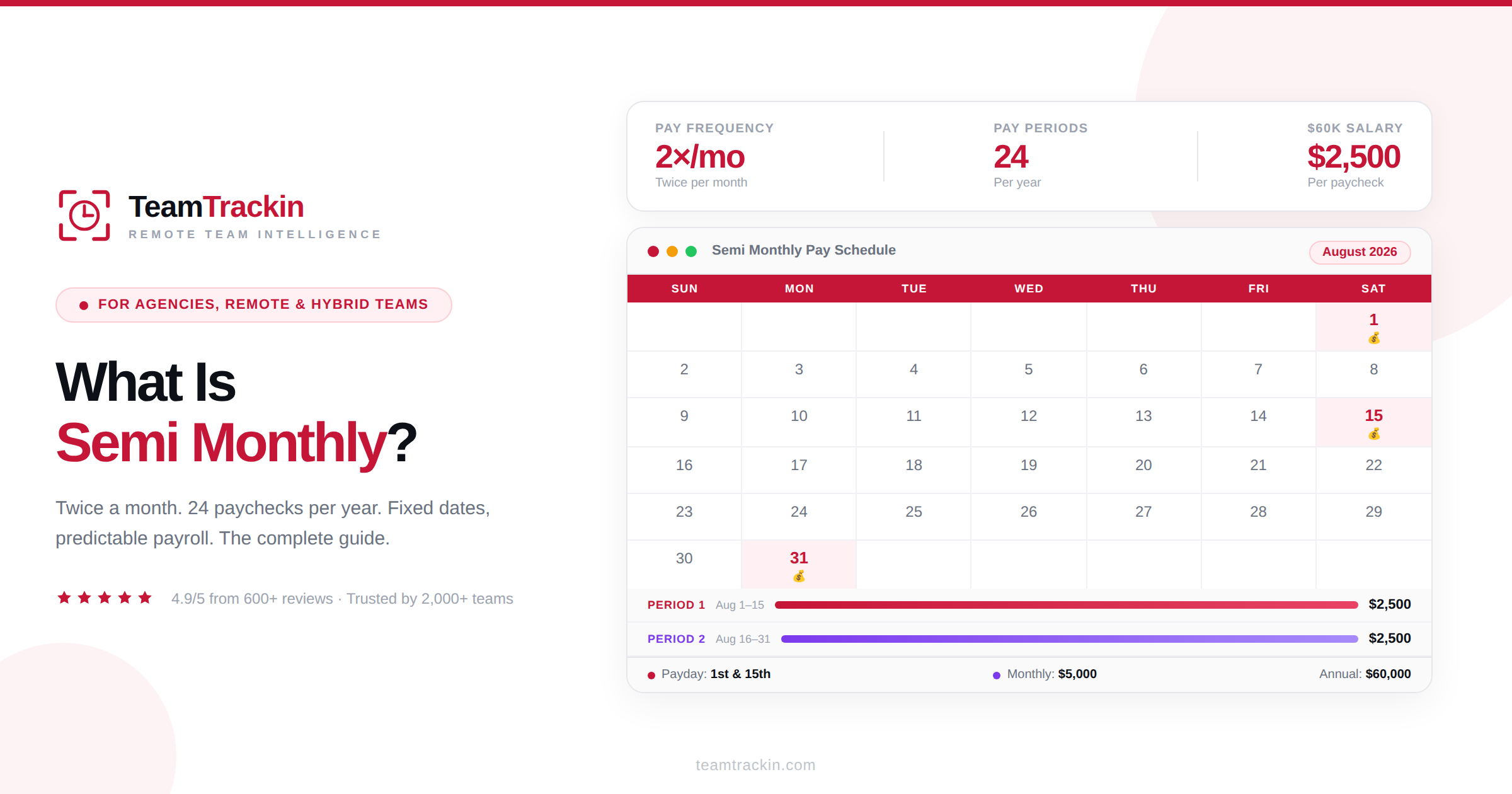
Semi monthly means twice a month. A semi monthly pay schedule pays employees on two fixed calendar dates each month — resulting in 24 paychecks per year. Here's the full breakdown: what it means, how many pay periods it includes, how to calculate semi monthly pay, and who should actually use this schedule.
Semi monthly means twice a month. The prefix "semi" means half — so semi monthly literally translates to "half-monthly," which means two times per month. In payroll, a semi monthly pay schedule pays employees on two fixed calendar dates each month, typically the 1st and 15th or the 15th and the last day of the month.
This results in exactly 24 pay periods per year — never 25, never 26. For a salaried employee earning $60,000 per year, each semi monthly paycheck would be $2,500 (annual salary ÷ 24). Semi monthly is not the same as biweekly, which pays every two weeks and produces 26 paychecks per year.
What Is Semi Monthly?
Semi monthly is a frequency term that means twice a month. In a business and payroll context, a semi monthly pay schedule pays employees on two fixed calendar dates each month — most commonly the 1st and 15th, or the 15th and the last day of the month — resulting in exactly 24 paychecks per year.
The term applies beyond payroll as well. A semi monthly board meeting happens twice a month. A semi monthly report is published twice a month. A semi monthly newsletter goes out twice a month. The frequency is always the same: two occurrences per calendar month, on predictable dates.
In practice, semi monthly is most commonly encountered in payroll and HR contexts. When a job offer states "paid semi monthly," it means the employee will receive two paychecks per month, each representing half a month's compensation. For salaried employees, each paycheck is exactly 1/24th of their annual salary. For hourly employees, each paycheck reflects the actual hours worked during that specific half-month period.
Semi monthly means twice a month — in payroll, it's a pay schedule that delivers two paychecks per month on fixed calendar dates, totaling exactly 24 pay periods per year.
What Does Semi Monthly Mean? Origin and Usage
To understand what semi monthly means, it helps to break the word apart. The prefix "semi" comes from Latin and means "half" or "partial." You see it in other common terms: a semicircle is half a circle, a semifinal is the round before the final, and a semiconductor partially conducts electricity.
When you attach "semi" to "monthly," the meaning is direct: half-monthly, or twice per month. This is different from the prefix "bi," which means "two" or "every two" — leading to the often-confused distinction between semi monthly and biweekly.
In everyday English, semi monthly is most often encountered in three contexts:
- Payroll: "We pay our employees semi monthly, on the 1st and 15th." This is by far the most common usage.
- Publishing: "The journal is published semi monthly." Meaning it releases two issues per month.
- Meetings and reports: "The executive committee meets semi monthly." Meaning twice per month on fixed dates.
Spelling: semi monthly, semi-monthly, or semimonthly?
All three forms — semi monthly (two words), semi-monthly (hyphenated), and semimonthly (one word) — are used in practice. Style guides differ: AP style generally avoids the hyphen (semimonthly), while many business documents use the hyphenated form (semi-monthly). Search engines treat all three as equivalent. For consistency, pick one form and use it across your organization — most modern HR and payroll software uses either "semi-monthly" or "semimonthly."
The "semi" prefix is unambiguous — it always means "half" or "twice per." This makes "semi monthly" a clearer term than "bimonthly," which can mean either "twice a month" or "every two months" depending on context. In any situation where precision matters — payroll, contracts, legal agreements — "semi monthly" is the safer choice because it can only be interpreted one way.
Is Semi Monthly Twice a Month?
Yes — semi monthly means exactly twice a month. This is the most straightforward answer to one of the most commonly asked payroll questions, and there is no ambiguity. An employee on a semi monthly pay schedule receives two paychecks every single month — no more, no less — totaling 24 paychecks per year.
The reason this question gets asked so frequently is confusion with biweekly pay. Biweekly means every two weeks, which usually results in two paychecks per month — but not always. Because there are 52 weeks in a year and not exactly 48 (which would be 4 weeks × 12 months), a biweekly schedule produces 26 paychecks per year. That means in two months each year, biweekly employees receive three paychecks instead of two.
Semi monthly eliminates this variability entirely. Regardless of whether a month has 28 days (February) or 31 days (January, March, etc.), the semi monthly schedule always delivers exactly two pay dates per month. The pay periods themselves vary in length — they can run anywhere from 13 to 16 days depending on the month — but the number of paychecks per month is always two.
Key distinction: "Twice a month" (semi monthly) and "every two weeks" (biweekly) sound similar but are mathematically different. Semi monthly = 24 paychecks/year. Biweekly = 26 paychecks/year. On a $60,000 salary, that's $2,500 per semi monthly check vs $2,307.69 per biweekly check. The annual total is the same — the per-check amount differs. For a detailed comparison, see our guide on bi-weekly vs semi-monthly pay.
Semi Monthly vs Bimonthly — Are They the Same?
In payroll, semi monthly and bimonthly are used interchangeably to mean "twice a month" — both refer to 24 pay periods per year on fixed calendar dates. However, outside of payroll, the two terms are not identical, and the confusion between them causes real problems.
The issue is that "bimonthly" is genuinely ambiguous. Depending on context, it can mean either "twice a month" (the same as semi monthly) or "once every two months" (the opposite meaning). A bimonthly magazine could publish 24 issues per year or 6 issues per year — and both interpretations are linguistically valid.
"Semi monthly" does not have this problem. The prefix "semi" always means "half" — so semi monthly can only mean "twice per month." There is no alternative interpretation.
| Term | What it means | Pay periods/year | Ambiguous? |
|---|---|---|---|
| Semi monthly | Twice a month (always) | 24 | No — unambiguous |
| Bimonthly | Twice a month OR every two months | 24 or 6 | Yes — context-dependent |
| Biweekly | Every two weeks | 26 | Sometimes confused with "twice a week" |
| Monthly | Once a month | 12 | No |
| Weekly | Once a week | 52 | No |
The practical advice: if you mean "twice a month," say semi monthly. It is the clearer, more precise term — especially in contracts, offer letters, employee handbooks, and any document where misinterpretation could create a payroll dispute.
How Does a Semi Monthly Pay Schedule Work?
A semi monthly pay schedule divides each calendar month into two pay periods, each with a corresponding pay date. The most common configurations are:
What happens when payday falls on a weekend or holiday?
If a scheduled semi monthly pay date falls on a Saturday, Sunday, or public holiday, the standard practice is to pay on the preceding business day. So if the 15th of a month falls on a Sunday, employees would typically receive their paycheck on Friday the 13th. Some companies pay on the next business day instead — Monday the 16th in this example. Either approach is acceptable as long as it is documented in the company's pay policy and applied consistently.
Semi monthly pay periods are not equal in length
Unlike biweekly pay, where every pay period is exactly 14 days, semi monthly pay periods vary in length. The first half of the month (1st through 15th) is always 15 days. The second half depends on the month: it could be 13 days (February in a non-leap year), 14 days (February in a leap year), 15 days (months with 30 days), or 16 days (months with 31 days).
For salaried employees, this variability does not affect their paycheck — each check is a fixed 1/24th of their annual salary regardless of how many days the pay period contains. For hourly employees, this variability matters directly because they are paid for actual hours worked, which differ from period to period.
How Many Pay Periods Are in Semi Monthly?
A semi monthly pay schedule has exactly 24 pay periods per year — two pay periods every month, twelve months per year: 2 × 12 = 24. This number never changes, regardless of the calendar.
This predictability is one of the primary reasons companies choose semi monthly over biweekly. With biweekly pay, the number of pay periods is usually 26 but can occasionally be 27 in certain calendar years (when the first payday falls on January 1st or 2nd). That 27th pay period creates accounting complications — budgeted annual labor costs suddenly have an extra pay cycle, benefit deductions need to be recalculated, and payroll reconciliation becomes more complex.
Semi monthly eliminates all of that. Twenty-four pay periods, every year, without exception. This makes it easier to:
- Budget annual labor costs: Each month's payroll expense is exactly the same for salaried employees.
- Process benefit deductions: Health insurance, retirement contributions, and other deductions are split evenly across 24 paychecks — 12 deductions for each half-month, exactly aligning with monthly premium cycles.
- Reconcile payroll with accounting: Each month has exactly two payroll transactions, which aligns cleanly with monthly financial statements.
Fewer pay periods mean larger individual paychecks. On a $72,000 annual salary: semi monthly = $3,000 per check (÷ 24), biweekly = $2,769.23 per check (÷ 26). The annual total is identical — but employees on a semi monthly schedule receive fewer, larger paychecks. For a deeper comparison, see our biweekly pay guide.
Semi monthly payroll starts with accurate time data.
TeamTrackin tracks hours in real time and generates payroll-ready timesheets for any pay schedule.
How to Calculate Semi Monthly Pay
The formula depends on whether the employee is salaried or hourly. Both are straightforward, but the hourly calculation has an important nuance that trips up many payroll teams.
For salaried employees
The formula is simple: Semi Monthly Pay = Annual Salary ÷ 24
| Annual Salary | Semi Monthly Paycheck (÷ 24) | Biweekly Paycheck (÷ 26) |
|---|---|---|
| $40,000 | $1,666.67 | $1,538.46 |
| $50,000 | $2,083.33 | $1,923.08 |
| $60,000 | $2,500.00 | $2,307.69 |
| $75,000 | $3,125.00 | $2,884.62 |
| $100,000 | $4,166.67 | $3,846.15 |
| $120,000 | $5,000.00 | $4,615.38 |
For hourly employees
The formula is: Semi Monthly Pay = Hourly Rate × Hours Actually Worked in That Pay Period
This is where semi monthly payroll gets more complex. Unlike salaried employees who receive a fixed amount, hourly employees must be paid for actual hours worked — and since semi monthly pay periods vary in length (13 to 16 days), the number of working days in each period differs. A commonly cited figure is 86.67 hours per semi monthly pay period (2,080 ÷ 24), but this is an annualized average, not an actual target. Hourly employees must be paid for real hours, not averaged hours.
Overtime complication: Under the Fair Labor Standards Act (FLSA), overtime for non-exempt employees is calculated by the workweek, not the pay period. Since semi monthly pay periods almost never align with complete workweeks — a pay period ending on the 15th will split a workweek in half — calculating overtime correctly requires tracking hours by workweek within each pay period. This is the single biggest operational challenge of semi monthly payroll for hourly teams.
Who Should Use a Semi Monthly Pay Schedule?
Semi monthly is not universally the best choice — it works exceptionally well for certain business models and team compositions, and creates unnecessary complexity for others. Here is how to evaluate fit:
Best for: salaried teams, agencies, and hybrid companies
Semi monthly pay is ideal when most or all of your workforce is salaried. Each paycheck is a simple, fixed amount (annual salary ÷ 24), benefit deductions align perfectly with monthly insurance premium cycles, and the consistent two-per-month rhythm makes budgeting predictable for both the company and employees. Agencies, consulting firms, and SaaS companies with predominantly salaried staff are natural fits.
For hybrid companies with both in-office and remote employees, semi monthly provides a single pay schedule that works regardless of location — there are no complications around which week employees are working remotely versus in-office.
More complex for: hourly-heavy and shift-based teams
If your workforce is primarily hourly, semi monthly payroll introduces friction. Variable pay-period lengths mean every paycheck requires actual-hours calculation (not a fixed amount). Overtime must be tracked by workweek within each pay period, which adds an extra layer of reconciliation. And some states — including Connecticut, Massachusetts, New Hampshire, and Vermont — actually require hourly employees to be paid weekly or biweekly, making semi monthly payroll non-compliant for hourly workers in those jurisdictions.
| Team Type | Semi Monthly Fit | Why |
|---|---|---|
| All salaried | ✅ Excellent | Fixed paycheck amounts, clean benefit deductions, predictable budgeting |
| Agencies / consulting | ✅ Excellent | Aligns with monthly client billing cycles and project accounting |
| Hybrid companies | ✅ Strong | Location-independent schedule, consistent across office/remote |
| Remote-first | ✅ Strong | Fixed dates work across time zones, no "which Friday" confusion |
| Mixed salaried + hourly | ⚠️ Moderate | Works but requires separate hour-tracking for hourly staff |
| Primarily hourly / shift-based | ❌ Not ideal | Variable period lengths, overtime tracking complexity, state law restrictions |
Common Semi Monthly Payroll Mistakes
Assuming 86.67 hours per period for hourly employees
The 86.67-hour figure (2,080 annual hours ÷ 24 periods) is an annualized reference, not a per-period reality. Semi monthly pay periods contain anywhere from 13 to 16 calendar days, and the actual number of workdays ranges from 9 to 12 depending on the month and where weekends fall. Hourly employees must be paid for actual hours worked in each specific period — using the 86.67 average can result in over- or under-payment in any given period.
Calculating overtime by pay period instead of by workweek
This is the most common compliance error in semi monthly payroll. Federal law (FLSA) requires overtime to be calculated on a workweek basis — typically a fixed 7-day period defined by the employer. Since semi monthly pay periods rarely start or end on the same day as the workweek, a single workweek often spans two pay periods. If overtime is calculated by pay period rather than by workweek, employees may be underpaid for overtime, creating a compliance violation.
Not adjusting pay dates for weekends and holidays
When the 1st or 15th falls on a Saturday, Sunday, or public holiday, the pay date must shift. Failing to define and communicate this adjustment rule in advance — whether you pay on the preceding Friday or the following Monday — creates confusion, missed expectations, and potential cash-flow issues for employees who rely on predictable deposit dates.
Using semi monthly for hourly workers in restricted states
Several US states mandate minimum pay frequencies that do not allow semi monthly for hourly employees. Before adopting a semi monthly schedule, verify your state's requirements. Some states require weekly or biweekly pay for hourly (non-exempt) workers, regardless of the employer's preference.
The common thread in semi monthly payroll errors is manual hour tracking and manual calculation. When time tracking software automatically captures hours by day, categorizes them by workweek, and generates pay-period-specific timesheets, the overtime-by-workweek calculation and actual-hours-per-period problems resolve themselves.
How TeamTrackin Supports Semi Monthly Payroll
Semi monthly payroll works best when the time data feeding it is accurate, real-time, and already structured by pay period. TeamTrackin provides exactly that — automatic time tracking that generates payroll-ready timesheets aligned to your semi monthly schedule.
The workflow
Frequently Asked Questions
- What is semi monthly?
Semi monthly means twice a month. In payroll, a semi monthly pay schedule pays employees on two fixed calendar dates each month — typically the 1st and 15th, or the 15th and the last day of the month. This results in exactly 24 pay periods per year. The prefix "semi" comes from Latin and means "half," so semi monthly literally translates to "half-monthly" or "twice per month."
- What does semi monthly mean?
Semi monthly means occurring twice each month. The prefix "semi" means "half" — so semi monthly literally means "half-monthly," which is twice per month. In payroll, it means employees receive two paychecks per month on fixed calendar dates. Outside of payroll, semi monthly can describe any event or schedule that happens twice a month — such as a semi monthly meeting, newsletter, or report.
- Is semi monthly twice a month?
Yes. Semi monthly means exactly twice a month. Employees on a semi monthly pay schedule receive two paychecks every month, on fixed calendar dates (such as the 1st and 15th), for a total of 24 paychecks per year. This is different from biweekly, which pays every two weeks and produces 26 paychecks per year.
- How many pay periods are in a semi monthly pay schedule?
A semi monthly pay schedule has exactly 24 pay periods per year — two pay periods every month, twelve months per year. This number never changes, regardless of how many days are in a month or which day of the week the pay date falls on. By contrast, biweekly pay has 26 pay periods per year (and occasionally 27 in certain calendar years).
- How do you calculate semi monthly pay?
For salaried employees: Semi Monthly Pay = Annual Salary ÷ 24. For example, a $60,000 annual salary results in $2,500 per semi monthly paycheck. For hourly employees: Semi Monthly Pay = Hourly Rate × Actual Hours Worked in the Pay Period. Since semi monthly pay periods vary in length (13 to 16 days), hourly employees must be paid for actual hours worked, not an average.
- Is semi monthly the same as bimonthly?
In payroll, semi monthly and bimonthly are often used interchangeably to mean "twice a month" (24 paychecks per year). However, outside of payroll, "bimonthly" is ambiguous — it can mean either "twice a month" or "once every two months." Semi monthly is the clearer term because it can only be interpreted one way: twice a month.
- Does TeamTrackin support semi monthly payroll?
Yes. TeamTrackin automatically tracks employee hours in real time and generates payroll-ready timesheets that align with any pay schedule, including semi monthly. Managers can set custom pay periods, review and approve timesheets for each period, and export the data directly to payroll — eliminating the manual hour tracking that makes semi monthly payroll complex.
Semi monthly payroll, simplified.
Track hours. Generate timesheets. Export to payroll.
TeamTrackin captures real work hours and builds payroll-ready timesheets for any pay schedule — semi monthly, biweekly, weekly. Try it free for 14 days.
Start Free Trial→14-day free trial · No credit card · Setup in ~3 minutes