
82% of people don't use a dedicated time management system. Here are 12 time management methods that do — each explained in plain language, with what current research says about how well it actually works.
- 82% of people have no dedicated time management system — most just react to whatever feels urgent.
- 50% of Eisenhower Matrix users report feeling in control of their tasks every single day — the highest of any method studied.
- 60% of Pomodoro Technique users feel in control of their workload 4-5 days a week.
- People who time block complete roughly 30% more tasks than those who work from an unstructured list.
- Despite the evidence, only 5% of people specifically use time blocking — most default to a plain to-do list.
What Is a Time Management Method?
A time management method is a structured, repeatable system for deciding what to work on and when — as opposed to a loose tip like "prioritize better," which sounds reasonable but gives no actual process to follow. A real method tells you exactly what to do: block this hour, work in this interval, rank tasks in this order.
Methods differ from techniques. A method is the overall system (the Eisenhower Matrix, GTD); a technique is a smaller tactic used within one (setting a timer, batching similar tasks). Most people benefit from picking one core method and layering a few techniques on top, rather than trying to run several full systems at once.
Time Blocking
Instead of deciding what to do next in the moment, the entire day is planned ahead of time and then executed against that plan. Popularized by Cal Newport in Deep Work, it works by turning vague intentions into calendar commitments.
Time Boxing
Unlike time blocking, which reserves time for a category of work, time boxing constrains one specific task so it can't quietly expand to fill the whole day. It's a favorite in Agile project management.
Pomodoro Technique
Developed by Francesco Cirillo in the late 1980s, it works by creating urgency and limiting decision fatigue — the short interval makes starting a task feel less daunting.
Eisenhower Matrix
Tasks that are both urgent and important get done first; important-but-not-urgent tasks get scheduled deliberately, rather than being pushed aside indefinitely. Research consistently rates it the most effective method by self-reported outcomes.
The 1-3-5 Rule
The fixed structure prevents the common trap of writing an unrealistic 20-item to-do list that guarantees a feeling of falling behind by lunchtime.
Task Batching
Answering all emails in one 30-minute block, for example, instead of checking inboxes constantly. It works by reducing the mental cost of context-switching between unrelated types of work.
Eat That Frog
Based on the idea that if the hardest task is done first, everything after it feels easier by comparison, and there's no room left in the day to keep postponing it.
Getting Things Done (GTD)
Developed by David Allen, it's built on the idea that mental clutter from unfinished tasks creates stress independent of the tasks themselves — the fix is capturing everything, not remembering harder.
The Pareto Principle (80/20 Rule)
Applied to time management, it means auditing your task list for the small number of activities that actually drive most of your results, and protecting time for those first.
The Two-Minute Rule
The logic is simple: the overhead of tracking, remembering, and revisiting a tiny task often costs more time than just doing it on the spot.
The ABCDE Method
It's a more granular alternative to the Eisenhower Matrix's four quadrants, useful for people with long daily lists that need a finer-grained ranking.
Kanban
Originally developed for manufacturing at Toyota, it's now widely used for both individual and team task management, particularly in software and creative teams.
Pick a method. Measure if it's working.
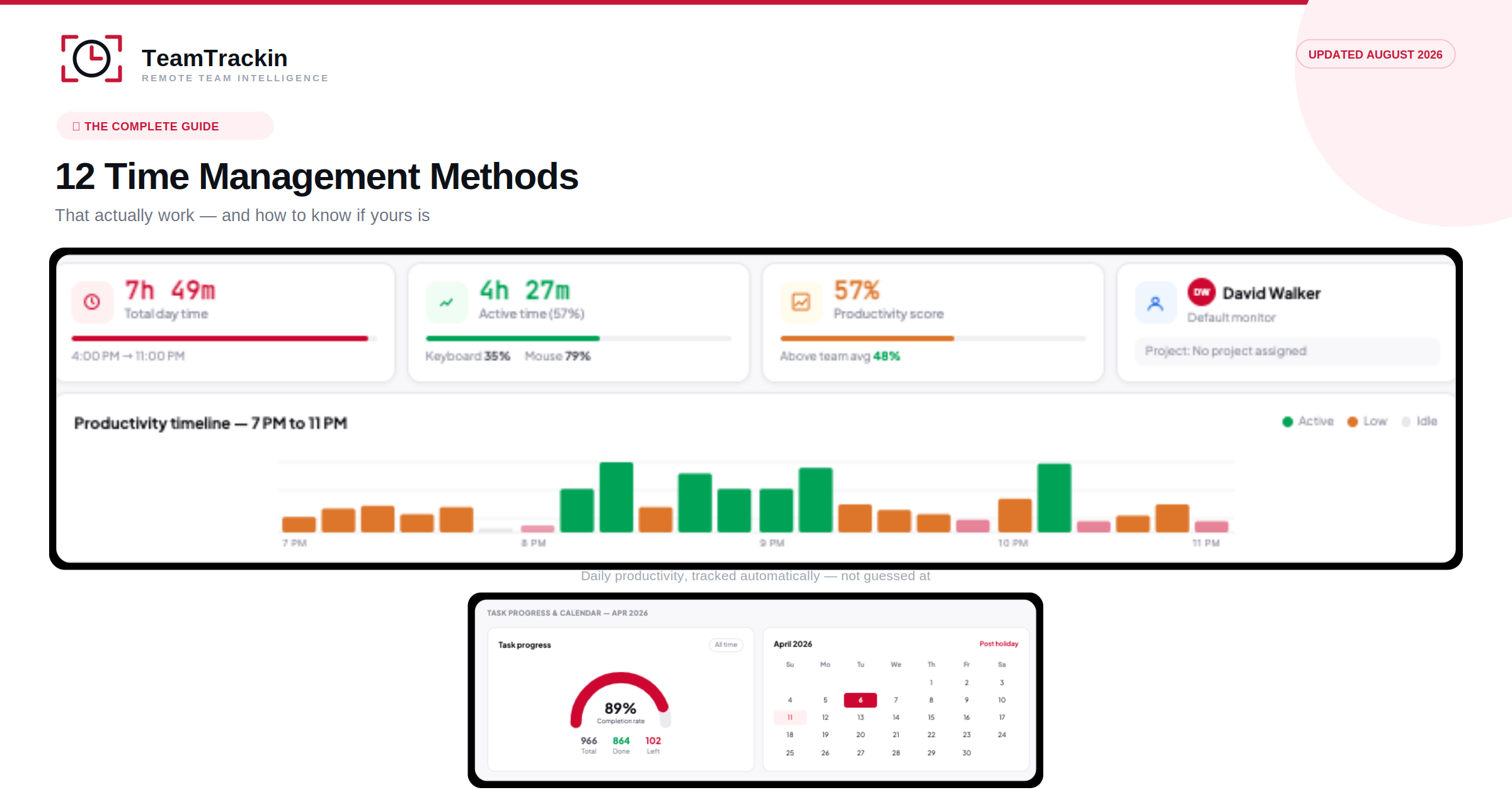
TeamTrackin tracks real time against tasks, so you know if a method is actually helping.
Time Management Methods Compared
| Method | Best For | Setup Effort |
|---|---|---|
| Time Blocking | Protecting focus time | Medium |
| Time Boxing | Open-ended tasks | Low |
| Pomodoro | Procrastination | Low |
| Eisenhower Matrix | Prioritization | Low |
| 1-3-5 Rule | Realistic daily planning | Low |
| Task Batching | Reducing context-switching | Medium |
| Eat That Frog | Procrastination on hard tasks | Low |
| GTD | Many small disconnected tasks | High |
| Pareto (80/20) | Cutting low-impact work | Medium |
| Two-Minute Rule | Small-task pileup | Low |
| ABCDE | Long task lists | Low |
| Kanban | Team workflow visibility | Medium |
How to Choose the Right Method
There's no single best time management method for everyone — the research is consistent on this point. The Eisenhower Matrix scores highest on self-reported control, but the method that actually helps is the one a person sticks with.
A practical starting point: if your biggest problem is procrastination, start with Pomodoro or Eat That Frog. If it's an overloaded task list, try the Eisenhower Matrix or the 1-3-5 Rule. If it's constant interruption, time blocking will do more for you than any prioritization method. Pick one, run it for two weeks, and measure the actual result before switching.
💡 The step most people skip: measuring whether a method is actually working. It's easy to feel like a new system is helping without any real evidence — tracking actual time against planned time is the only way to know for sure.
Frequently Asked Questions
- What are time management methods?
Time management methods are structured systems for deciding what to work on and when, such as time blocking, the Pomodoro Technique, or the Eisenhower Matrix. They differ from general productivity tips in that they provide a repeatable, specific process rather than loose advice like "prioritize better."
- What is the most effective time management method?
Research suggests the Eisenhower Matrix is the most effective time management method by self-reported outcomes — 50% of users say they feel in control of their tasks every day, the highest of any method studied. However, the most effective method for any individual is ultimately the one they use consistently; a highly-rated method abandoned after a week delivers no benefit.
- What is the difference between a time management method and a technique?
A time management method is a broader system for organizing and prioritizing work, such as the Eisenhower Matrix or Getting Things Done. A technique is typically a smaller, specific tactic used within or alongside a method, such as setting a timer or batching similar tasks. Methods provide the overall structure; techniques are the tools used to execute it day to day.
- Do time management methods actually work?
Yes, when used consistently. Research shows measurable effects: people who time block complete roughly 30% more tasks than those who don't, and 60% of Pomodoro Technique users report feeling in control of their workload most of the week. The evidence is strongest for methods practiced regularly rather than tried once and abandoned.
- How does TeamTrackin support time management methods?
TeamTrackin tracks actual time spent on tasks and projects, giving people and teams the real data needed to see whether a time management method is working — rather than guessing based on how a day felt. Most time management methods fail not because the method is wrong, but because there's no way to measure whether it's actually being followed.
Pick a method. Track the results.
TeamTrackin shows exactly where your time goes, so you can tell what's actually working — trusted by 2,000+ teams.
Explore TeamTrackin→