
If your business relies on employees working scheduled shifts, billable hours, or project-based tasks, there is one question that quietly costs you money every single day: are you tracking time accurately? For decades, businesses relied on paper timesheets, manual punch cards, and honour systems. Employees estimated their hours. Managers approved without checking. Payroll teams did their best with the data they were given. The result? Overpaid hours, underbilled clients, and payroll disputes that drain time, money, and morale. Time clock software exists to solve exactly this problem. It replaces guesswork with real data — capturing exactly when employees start work, when they take breaks, and when they finish. And in 2026, the best employee time clock software goes far beyond a simple punch-in system, integrating with payroll, project management, compliance reporting, and workforce analytics. In this guide, we cover everything you need to know: what time clock software is, why it matters, what features to look for, how to choose the right solution for your business — from small shops to enterprise teams — and how TeamTrackin delivers all of it in one streamlined platform. Time clock software is a digital system that records when employees begin and end their working hours. Unlike paper timesheets or manual logs, it captures this information automatically, accurately, and in real time — creating a reliable audit trail that can be used for payroll processing, client billing, compliance reporting, and workforce management. Modern employee time clock software typically offers multiple clock-in methods to suit different working environments: Web browser clock-in from a desktop or laptop Mobile app clock-in for remote and field-based workers GPS-based location verification to confirm employees are where they should be Biometric or PIN-based clock-in from shared devices or kiosks Project and task-based time logging for professional services teams The data captured is stored centrally and made available to managers, HR teams, and payroll administrators in real time. This transforms time tracking from a reactive, end-of-week administrative task into a live operational intelligence tool — one that helps businesses understand how their workforce time is being spent, identify inefficiencies, and make better staffing decisions. The financial impact of poor time tracking is rarely visible until it is measured. When employees estimate their hours at the end of the week, they round up. When managers approve without checking, inaccuracies compound. When payroll processes these numbers, businesses pay for time that was never worked. But the cost goes beyond payroll. For businesses that bill clients by the hour — agencies, consultancies, legal firms, IT service providers — inaccurate time logs mean under-billed projects, revenue leakage, and clients who receive no clear record of the value being delivered. Time clock software makes every hour countable and provable. The widespread adoption of remote and hybrid working has made time tracking simultaneously more important and more challenging. When employees are not in a shared office, visibility into how work time is being used becomes critical. The best employee time clock software accounts for this — offering GPS verification, screenshot monitoring, and activity tracking tools that give managers genuine insight regardless of where their teams are working. UK employment law, Working Time Regulations, and HMRC requirements mean that businesses need accurate records of the hours their employees work. Whether it comes to overtime calculations, rest period compliance, or a disputed employment tribunal, having a reliable, timestamped log of working hours is not just good practice — it is essential protection. Integrating time clock software with payroll eliminates one of the most error-prone steps in the payroll process: manual data entry. When hours are captured automatically and fed directly into payroll calculations, the risk of human error falls dramatically — and payroll runs faster. Not all time clock solutions are equal. When evaluating which platform is right for your business, these are the features that separate genuinely useful software from tools that simply digitise the problem without solving it. Your workforce is not all in the same place, working the same way. The best time clock software supports multiple clock-in options — web, mobile, GPS, biometric, or PIN — so that every employee can record their time accurately regardless of their working environment. A field engineer, an office administrator, and a remote developer all have different needs. Your time clock software should accommodate all of them. Knowing who is currently clocked in, who is on a break, and who has not started their shift is information that managers need immediately — not at the end of the day when it is too late to act. Real-time dashboards give operational leaders instant visibility into workforce attendance and activity. Overtime management is one of the most complex and error-prone areas of workforce administration. Time clock software should automatically calculate overtime based on your configured rules — whether that is anything over eight hours per day, over forty hours per week, or a custom threshold — and flag exceptions for manager review. For professional services businesses, time is not just an attendance measure — it is the unit of billing. Time clock software that supports project-based logging allows employees to allocate their hours to specific clients, projects, or tasks. This data then flows directly into invoicing and client reporting, creating a seamless record from hours worked to invoice sent. For businesses with mobile or field-based workforces — construction, healthcare, logistics, facilities management — GPS-verified clock-ins confirm that employees are genuinely on-site when they record their time. This eliminates buddy punching and time fraud in environments where managers cannot be physically present. The most time-saving feature of any employee time clock software is direct integration with payroll. When hours flow automatically from time tracking into payroll calculations, manual data entry is eliminated, errors are reduced, and the payroll process shrinks from hours to minutes. Every time entry should be timestamped, immutable, and auditable. Good time clock software maintains a complete historical record of all clock-ins, clock-outs, edits, and approvals — giving HR and legal teams the documentation they need in the event of a dispute or regulatory audit. Time clock software should not operate in isolation from your leave management process. When annual leave, sick days, and absences are tracked in the same system as working hours, managers get a complete picture of workforce availability — and payroll deductions are calculated automatically. With so many options available, knowing how to choose time clock software that fits your specific business is critical. Here is a structured framework that works whether you are a retail store owner, a professional services firm, or a growing enterprise. Start by understanding how your employees work. Are they office-based, remote, field-based, or a mix? Do they work fixed shifts or flexible hours? Are they salaried or paid hourly? The answers to these questions determine which clock-in methods and features you actually need. Is your biggest problem payroll accuracy? Client billing? Compliance documentation? Manager visibility? Or all of the above? Prioritising the problem you most urgently need to solve will help you evaluate software against the criteria that matter most to your business — rather than being distracted by features you will never use. Time clock software for small business environments has different requirements to enterprise platforms. Small businesses typically need simplicity, affordability, and fast setup. They do not need complex configuration, dedicated implementation support, or enterprise-grade permission hierarchies. Look for a platform that is designed to scale — starting simple and growing with you as your team expands. Your time clock software should connect seamlessly with the tools you already use — particularly your payroll provider, accounting software, and project management system. Poor integrations mean manual data transfers, which reintroduce exactly the errors that time clock software is designed to eliminate. In 2026, any time clock software that does not offer a strong mobile experience is already behind. Your employees need to clock in from their phones — whether they are arriving at a job site, starting a remote work session, or logging task time during a client visit. Test the mobile app thoroughly before committing. Raw time data is useful. Intelligently structured reports are transformative. Look for time clock software that surfaces insights — overtime trends, attendance patterns, project profitability, cost per department — in a format that managers and finance teams can actually act on. The best time clock software providers offer a free trial — and you should take it. There is no substitute for testing a platform with your own data, your own team, and your own workflows. A free trial lets you evaluate usability, mobile performance, and integration quality before making a financial commitment. Retail and store-based businesses have specific requirements that not all time clock platforms address well. Here is what to prioritise if you are choosing time clock software for a store environment. Retail operates on shifts — and your time clock software needs to know what those shifts are. When employees clock in late, leave early, or miss a shift entirely, the system should flag these exceptions immediately so managers can respond before it becomes a customer service issue. If you operate more than one store, your time clock software needs to handle multiple locations cleanly — tracking which employees are clocked in at which site, flagging cross-location anomalies, and producing consolidated reports across all sites. Employment law requires that employees receive adequate rest breaks during long shifts. Time clock software for retail should track break periods automatically and alert managers if rest periods are being missed — protecting both employees and the business from compliance risk. Retail environments have high staff turnover and busy managers with limited training time. The clock-in process needs to be intuitive enough that a new employee can use it on day one without instruction. Look for a simple PIN or mobile clock-in that requires minimal setup and zero training overhead. At the end of each pay period, your time data needs to flow cleanly into payroll. Whether that means a direct integration with your payroll provider or a formatted export file, the process should take minutes — not hours of manual reconciliation. If you have been searching for the best employee time clock software in 2026, you have likely encountered a wide range of options — from standalone time clocks to broad HR platforms with time tracking bolted on. Here is what makes TeamTrackin a compelling choice across every category of business. TeamTrackin is designed for the way businesses actually operate — with remote employees, hybrid teams, field workers, and office-based staff all working alongside one another. Clock-in works via browser, mobile app, or GPS-verified location, accommodating every working environment without requiring additional hardware or complex configuration. Unlike basic time clock tools that simply record start and end times, TeamTrackin allows employees to log time against specific projects, clients, and tasks. This makes it the best employee time clock software for professional services teams who need to track billable hours with precision and produce client-facing time reports. TeamTrackin's overtime management engine automatically calculates overtime based on your configured rules and flags exceptions in real time. This removes one of the most common sources of payroll errors and gives HR teams the confidence that every overtime hour is being tracked, approved, and compensated correctly. Managers do not have to wait for an end-of-day report to know what is happening. TeamTrackin's live dashboard shows who is clocked in, who is on a break, who has not started their shift, and which projects are receiving time right now. This level of visibility transforms operational decision-making. TeamTrackin integrates with leading payroll and accounting platforms, meaning that approved hours flow directly into payroll calculations without manual data entry. This single integration typically pays for the software subscription within the first month. TeamTrackin offers a full-featured free trial that gives you access to the complete platform — time clock, project tracking, reporting, payroll integration, and more — so you can evaluate it against your own team's needs before making any financial commitment. While virtually every business with employees benefits from accurate time tracking, certain sectors see particularly high returns: Law firms, marketing agencies, accountancy practices, and consulting businesses bill clients by the hour. For these businesses, every untracked minute is unbilled revenue. Time clock software with project-based logging and client reporting is not optional — it is the foundation of profitability. Shift-based businesses need to know that employees are clocking in on time, taking the right breaks, and not exceeding scheduled hours in a way that triggers unplanned overtime costs. Time clock software gives retail and hospitality managers the visibility to manage this in real time. When employees are working across multiple job sites, knowing that they are on-site and working — not clocking in from somewhere else — requires GPS verification. Time clock software with geolocation confirmation is essential for construction, facilities management, and field services teams. Care homes, community healthcare providers, and private clinics operate under strict compliance requirements around working hours and rest periods. Time clock software creates the audit trail needed to demonstrate compliance with staffing regulations and Working Time Directive requirements. For businesses managing distributed teams across multiple locations and time zones, time clock software is the connective tissue that keeps workforce visibility intact. Without it, managers are operating on trust alone — with no data to support resource planning, performance management, or client billing. One of the most common hesitations about adopting time clock software is the fear of implementation disruption — getting staff to adopt a new system, migrating data, and retraining managers. Here is how to make the transition as smooth as possible. Start with a pilot group. Roll out the software to one department or location first. This allows you to identify any adoption issues before scaling across the whole business. Communicate the why. Employees are more likely to embrace a new system when they understand the reason for it. Frame time clock software as a tool that makes payroll more accurate and fair — not as a surveillance measure. Keep clock-in simple. The clock-in method your employees use needs to be fast, intuitive, and reliable. If it adds friction to the start of every working day, adoption will suffer. TeamTrackin's mobile app clock-in typically takes under ten seconds. Integrate with payroll from day one. The most powerful demonstration of the software's value is the first payroll run that happens automatically from tracked hours. Make sure the payroll integration is configured before go-live. Use the reporting tools. Do not let the data sit unused. From the first week, run overtime reports, attendance summaries, and project hour breakdowns. The insights will quickly justify the investment and drive further engagement from management. Time clock software is a digital platform that records when employees start and end their working hours, replacing paper timesheets and manual punch cards with accurate, automated time capture. Modern platforms also support project-based time logging, GPS verification, payroll integration, and compliance reporting. The best employee time clock software depends on your business size, workforce type, and integration requirements. For businesses looking for a complete workforce management platform that combines time tracking with project management, HR automation, and client reporting, TeamTrackin is a market-leading option. For freelancers or very small teams, simpler tools may suffice. Yes. Time clock software for small businesses does not need to be complex or expensive. TeamTrackin is designed to be set up in minutes, requires no hardware, and offers a free trial — making it accessible for businesses of any size. Small businesses often see the fastest ROI because every recovered payroll error has an immediate impact on a tighter budget. Time clock software prevents time theft through GPS-verified clock-ins that confirm employees are on-site, biometric or PIN-based authentication that prevents buddy punching, and automated alerts when clock-ins occur outside expected working hours or locations. These controls eliminate the most common forms of time theft without requiring managers to police attendance manually. Yes. Leading time clock platforms including TeamTrackin integrate directly with popular payroll providers, meaning approved hours flow automatically into payroll calculations. This eliminates manual data entry, reduces errors, and significantly speeds up the payroll processing cycle. For retail and store environments, prioritise shift schedule integration, multi-location support, break tracking, and a simple clock-in method that requires minimal training. Your time clock software should flag late arrivals and early departures automatically and produce payroll-ready exports at the end of each pay period. Yes. TeamTrackin offers a full-featured free trial with no credit card required. You can access the complete platform — time clock, project tracking, HR tools, and reporting — and evaluate it against your business needs before committing. Start your trial at teamtrackin.com. Time is the most valuable resource your business manages. Every hour your employees work is a cost on your P&L — and either a billable asset or a wasted one, depending on how accurately it is tracked and allocated. Time clock software transforms this from a guessing game into a precision instrument. It tells you exactly when your team is working, what they are working on, whether hours are being used productively, and how to translate that data into accurate payroll, fair billing, and smart workforce planning. Whether you are a small retail business trying to eliminate payroll errors, a professional services firm that needs to prove every billable hour to clients, or a growing enterprise managing a distributed workforce across multiple locations — there is a time clock software solution designed for your needs. And if you want a platform that combines employee time clock software with project management, HR automation, recruitment tools, and a client portal — all in one integrated system — then TeamTrackin is built for exactly that.What Is Time Clock Software?
Why Time Clock Software Matters in 2026
The Cost of Inaccurate Time Tracking
The Rise of Remote and Hybrid Work
Compliance and Employment Law
Payroll Accuracy and Speed
Key Features to Look for in Time Clock Software
1. Multiple Clock-In Methods
2. Real-Time Dashboard and Manager Visibility
3. Automated Overtime Calculations
4. Project and Task-Based Time Tracking
5. GPS Location Tracking
6. Payroll Integration
7. Compliance and Audit Reporting
8. Leave and Absence Management
Manual Timesheets vs Time Clock Software: A Direct Comparison
How to Choose Time Clock Software for Your Business
Step 1: Define Your Workforce Profile
Step 2: Identify Your Primary Pain Point
Step 3: Consider Your Business Size
Step 4: Check Integration Compatibility
Step 5: Evaluate the Mobile Experience
Step 6: Assess Reporting and Analytics
Step 7: Try Before You Buy
How to Choose Time Clock Software for a Store or Retail Business
Shift Scheduling Integration
Multiple Locations
Break and Rest Period Tracking
Simple, Low-Training Clock-In
Payroll Ready Export
What Is the Best Employee Time Clock Software? How TeamTrackin Compares
Built for Real Workforce Complexity
Project and Task-Level Tracking
Automated Overtime and Compliance
Real-Time Manager Dashboard
Seamless Payroll Integration
Free Trial — No Commitment
Best Time Clock Software Compared: TeamTrackin vs Alternatives
Which Businesses Benefit Most from Time Clock Software?
Professional Services and Agencies
Retail and Hospitality
Construction and Field Services
Healthcare and Care Sector
Remote and Hybrid Teams
How to Implement Time Clock Software Without Disrupting Your Business
Frequently Asked Questions About Time Clock Software
What is time clock software?
What is the best employee time clock software in 2026?
Is there good time clock software for small businesses?
How does time clock software prevent time theft?
Can time clock software integrate with payroll?
How to choose time clock software for a store?
Does TeamTrackin offer a free trial?
Conclusion: Make Every Hour Count
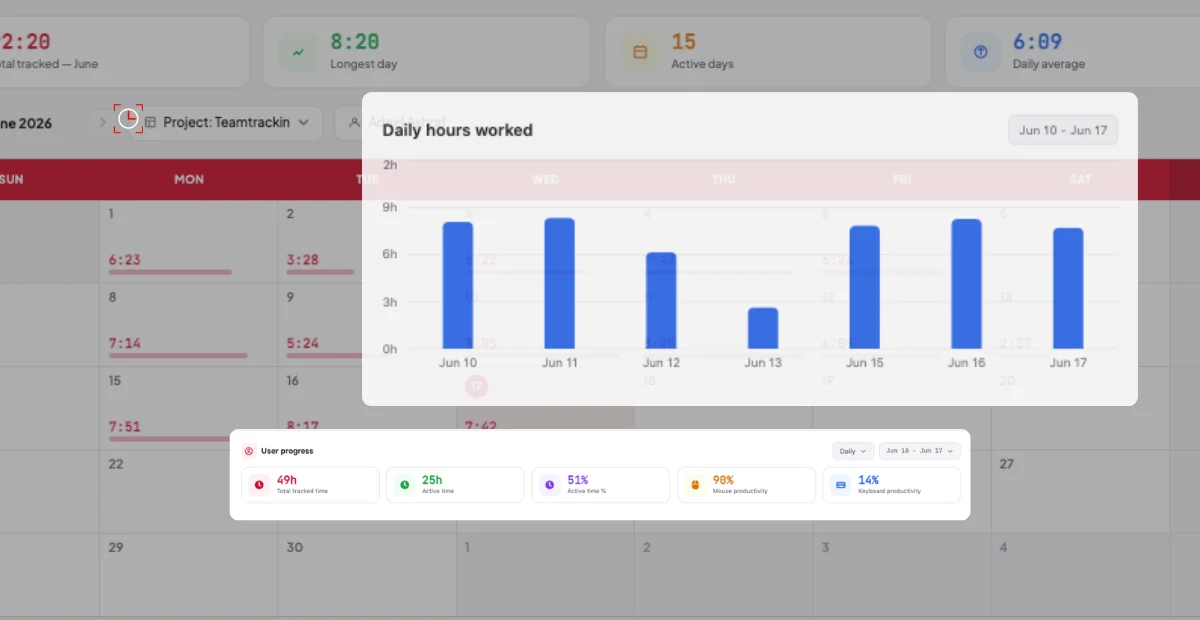
Time Clock Software: The Complete Guide for Businesses in 2026
Ready to see what accurate, automated time tracking looks like for your team?
Start your free 14-day trial of TeamTrackin today — no credit card required, full access from day one.
Start Free Trial