
Team productivity is one of the most searched-for topics in business management — and for good reason. Whether you are running a 10-person startup, a 200-person enterprise, a creative agency, or a distributed BPO operation, the same question drives every manager: how do we get more done, better, without burning people out? The challenge in 2026 is that teams are no longer all in one room. 52% of workers globally are now hybrid, and remote-first setups are standard across sectors. Traditional productivity advice — sit next to your team, have more stand-ups, fill the whiteboard — simply does not apply to the way most modern teams actually work. This guide gives you 10 practical, evidence-backed ways to boost team productivity right now. Each tip works whether your team is fully remote, hybrid, or in-office — and we have included specific guidance on the tools and approaches that make the biggest difference. The single biggest drain on team productivity is ambiguity. When people do not know exactly what they are working toward, they default to staying busy rather than staying effective. Use the OKR (Objectives and Key Results) or SMART goal framework to give every team member clear targets at the individual, project, and company level. Review them in weekly check-ins — not to micromanage, but to remove blockers before they become bottlenecks. For remote and hybrid teams, written goals matter even more. What gets written down gets done. What stays verbal disappears by Wednesday. Basic time tracking tells you how many hours were worked. Project time tracking tells you where those hours went and whether they produced the right output. When teams track time at the task and project level, managers can see which projects are over-consuming resources, which clients are underserviced, and where team members need support. This is the difference between running a reactive business and a proactive one. Tools like TeamTrackin automate this process entirely — employees do not need to manually log hours. The platform captures time in the background and maps it to projects automatically, generating accurate, payroll-ready timesheets without any admin burden. Meetings are one of the most expensive productivity drains in modern organisations. Research shows that teams using async-first communication methods waste 45% less time in meetings and see individual output rise by up to 20%. The fix is not to eliminate all meetings — it is to be intentional. Synchronous time (live meetings) should be reserved for decisions, creative brainstorming, and relationship-building. Everything else — updates, status reports, feedback, approvals — should be async. Set a team norm: before scheduling a meeting, ask whether this could be a written update, a Loom video, or a comment thread. You will reclaim hours every week. When work is invisible, it stalls. A Kanban board makes work visible — every task has a status, an owner, and a deadline. Blockers surface immediately rather than lurking until a deadline is missed. For agencies managing multiple client projects, BPOs tracking agent workloads, and enterprises overseeing cross-departmental initiatives, visual workflow management is one of the highest-ROI changes a team can make. TeamTrackin's built-in Kanban board lets teams organise tasks by project, assign priorities, track percentage completion, and spot bottlenecks in real time — without needing a separate project management tool. Context-switching is the silent killer of team productivity. Every time a team member shifts from a complex task to a Slack message and back, research suggests it takes an average of 23 minutes to fully regain focus. Introduce structured focus blocks — protected hours where notifications are paused and deep work happens. For remote and hybrid teams, this also means establishing a team norm around response time expectations: being available instantly is not the same as being productive. Pair focus blocks with activity monitoring that shows when your team is most productive. Some people peak in the morning; others do their best work in the afternoon. The best team productivity software surfaces these patterns so managers can schedule meetings and collaboration around them. HR admin — timesheet collection, leave approvals, overtime calculations, payroll preparation — absorbs hours every week that could go toward meaningful work. For growing businesses, this overhead scales badly. Automating these processes with a unified workforce management platform pays back immediately. Automated timesheets, one-click leave approvals, and payroll-ready exports eliminate the manual grind, reduce errors, and free managers to focus on people rather than paperwork. Most team productivity problems are invisible until they become crises. The manager who notices burnout, missed deadlines, and scope creep is usually doing so at retrospect — weeks after the damage was done. Real-time productivity dashboards change this. When you can see, at a glance, which team members are overloaded, which projects are over-budget, and where active work hours are being concentrated, you can intervene early. This is the difference between best team productivity practices and ordinary management. Data-driven decisions are faster, fairer, and more defensible than gut feeling — especially when managing distributed teams across time zones. Micromanagement is the fastest way to destroy team productivity. When employees feel watched rather than trusted, they shift energy from doing good work to looking like they are doing good work — a crucial and expensive difference. Trust-based productivity means measuring outcomes, not activity. It means giving employees the information they need to self-manage, and intervening only when data shows a genuine problem. According to a 2025 Gallup study, teams with effective managers report four times higher engagement — regardless of whether they work remotely or in-office. Ethical monitoring tools that are transparent to employees — where everyone can see their own data and understand what is tracked — build the kind of accountability culture where productivity grows naturally. Teams that use the right productivity tools consistently outperform those that do not. The challenge is tool sprawl — when a team uses five different platforms for time tracking, project management, HR, communication, and reporting, the integration gaps between them become productivity black holes. The top team productivity software solutions in 2026 consolidate these functions into one cohesive platform. This reduces context-switching between apps, eliminates data silos, cuts subscription costs, and gives everyone — managers and employees — a single source of truth. TeamTrackin combines time tracking, project and task management, HR automation, activity monitoring, and payroll reporting in one platform. One login. One dashboard. One source of truth for how your team's time translates into output. The teams that consistently achieve the best team productivity are not the ones who found a perfect system once and stuck with it. They are the ones who review what worked, identify what slowed them down, and adjust every cycle. Build a regular retrospective into your team rhythm — weekly, fortnightly, or per sprint. Review actual time data against estimates. Look at which types of work consumed the most hours relative to value delivered. Ask the team where they felt most and least effective. This continuous improvement loop is what separates high-performing teams from average ones. The data your time tracking and productivity tools generate is only valuable if it informs future decisions. Most productivity advice fails not because it is wrong — but because the tools available to implement it are scattered, complex, or invasive. TeamTrackin was built to close that gap. As one of the most comprehensive team productivity software platforms for modern distributed teams, TeamTrackin brings everything you need into one place: Automatic time tracking — background capture across Windows, Mac, and Linux, with no manual entry required Project and task management — full Kanban board, milestone tracking, and budget visibility built in Productivity dashboards — real-time activity insights that highlight trends, workload imbalances, and focus patterns HR automation — leave management, overtime tracking, and payroll-ready exports to Xero, QuickBooks, and more Ethical monitoring — optional screenshots for accountability, zero keystroke logging, transparent to all employees Role-based access — the right data to the right people, with full audit logging for enterprise compliance Whether you are a startup trying to build productive habits from day one, an agency managing multiple client accounts, a BPO scaling a remote operation, or an enterprise running distributed teams across time zones — TeamTrackin gives you the visibility and automation to boost team productivity without adding complexity or creating surveillance culture. The most effective approach combines three things: clear goals with measurable outcomes, automatic time tracking at the project level, and a trust-based culture that uses data to support people rather than surveil them. Remote teams that implement all three consistently outperform those relying on attendance monitoring or meeting-heavy management. The best team productivity software consolidates time tracking, project management, HR automation, and productivity analytics in one platform. TeamTrackin is built for exactly this — serving remote teams, hybrid businesses, agencies, BPOs, and enterprises with a single all-in-one platform that eliminates app sprawl and gives managers real-time visibility into how work gets done. Accurate team productivity measurement requires tracking hours at the task and project level (not just total daily hours), comparing time estimates against actuals, and reviewing output quality alongside time spent. Automated timesheets connected to project data give managers the most reliable and actionable productivity picture. Yes — but only when it is designed for adoption and trust. Productivity tools that employees actively use because they see value in them (accurate timesheets, fair performance visibility, automated admin) drive significantly better outcomes than surveillance tools that employees try to game or avoid. High-performing hybrid and remote teams consistently do four things: they define and document goals clearly, they protect focused work time, they use async communication by default, and they review real data from their productivity tools in regular retrospectives. The teams that struggle are typically those managing by presence rather than output. Ready to Boost Your Team Productivity? TeamTrackin combines time tracking, project management, HR automation, and productivity insights in one platform — built for remote teams, hybrid businesses, agencies, and enterprises worldwide.Define Clear Goals and Measurable Outcomes
Track Time Against Projects — Not Just Hours
Reduce Meeting Overload with Async-First Communication
Use a Kanban Board to Visualise Workflow
Protect Deep Work Time with Focus Blocks
Automate Repetitive HR and Admin Tasks
Use Productivity Data — Not Gut Feeling — to Make Decisions
Build a Culture of Trust and Transparency
Invest in the Right Team Productivity Software
Review, Reflect, and Iterate — Every Sprint
Quick Reference: 10 Ways to Boost Team Productivity
How TeamTrackin Helps You Implement Every One of These Strategies
Frequently Asked Questions
What is the most effective way to boost team productivity for remote teams?
What is the best team productivity software in 2026?
How do you measure team productivity accurately?
Can productivity software really improve team output?
How do hybrid and remote teams maintain high team productivity?
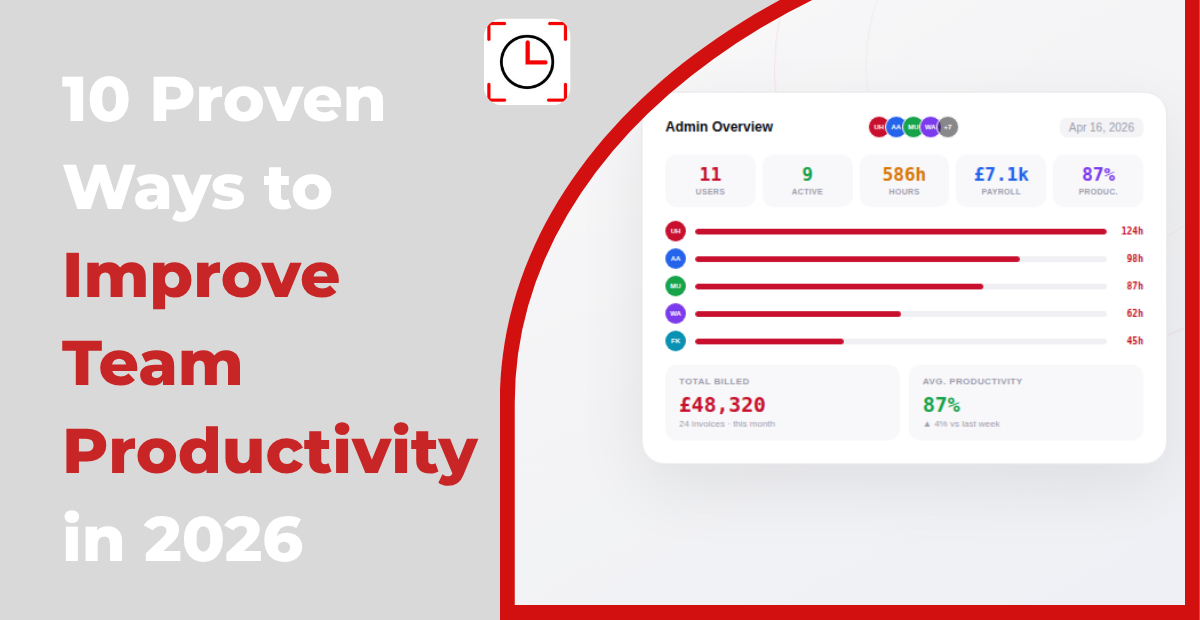
10 Proven Ways to Improve Team Productivity in 2026
Ready to see what accurate, automated time tracking looks like for your team?
Start your free 14-day trial of TeamTrackin today — no credit card required, full access from day one.
Start Free Trial