
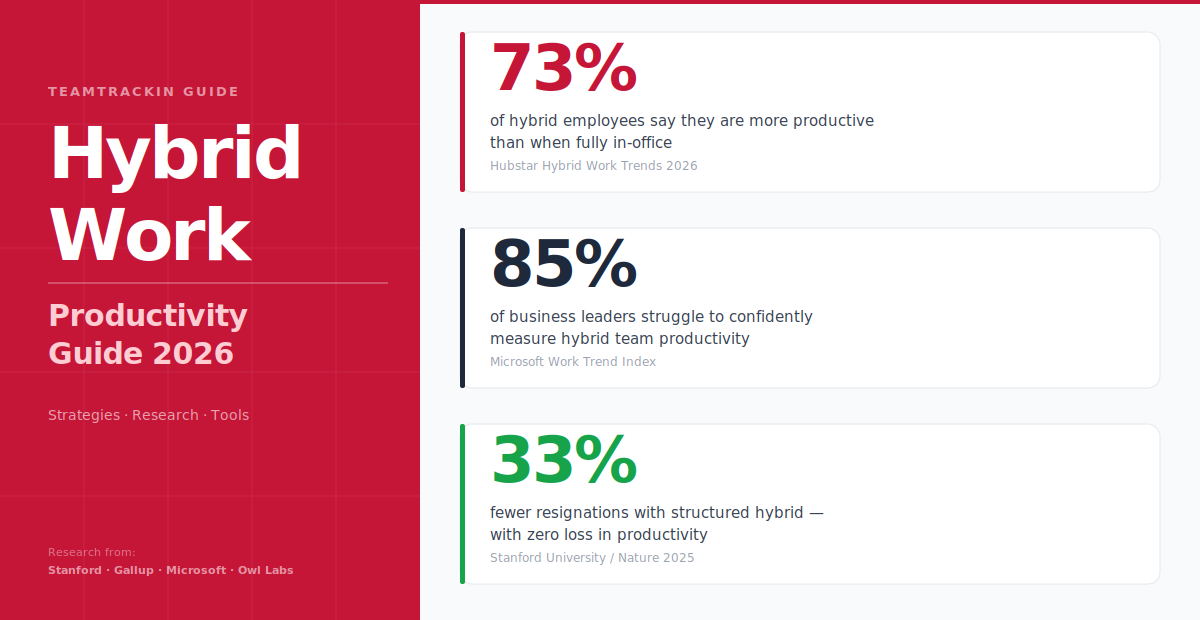
73% of employees say hybrid work makes them more productive. Yet 85% of managers say they struggle to measure it. This guide closes that gap — with peer-reviewed research, proven strategies, and practical tools that give every hybrid team the visibility it needs to perform at its best.
of employers globally now offer some form of hybrid work
Robert Half, 2026
of hybrid employees say hybrid work makes them more productive
Hubstar Hybrid Work Trends 2026
of business leaders struggle to confidently measure hybrid productivity
Microsoft Work Trend Index
fewer resignations in structured hybrid models with no productivity loss
Stanford / Nature, 2025
Hybrid work productivity refers to how effectively employees perform when splitting their working week between a home or remote location and a company office. Research consistently shows that well-structured hybrid models increase productivity — Stanford research found no productivity loss with structured hybrid and a 33% reduction in resignations, and 73% of hybrid employees self-report being more productive than when fully in-office.
However, the productivity effects of hybrid work depend almost entirely on three factors: the quality of communication systems, the clarity of performance metrics, and the presence of fair, consistent measurement frameworks. Hybrid teams without structured time tracking, clear KPIs, or output-based reviews consistently underperform their potential — not because of where they work, but because of how their work is measured.
Does Hybrid Work Increase Productivity? What the Research Actually Says
The debate over whether hybrid work increases or decreases productivity has been running since 2020, and for most of that time, the answer has been clouded by anecdote, ideology, and the interests of real estate portfolios. In 2026, the research base is large enough to give a clear answer.
The short answer: yes — when structured correctly.
The most rigorous large-scale study of hybrid work was conducted by Stanford economist Nicholas Bloom with Trip.com, involving 1,612 employees randomly assigned to hybrid or full-time office schedules. The results: hybrid workers showed no productivity loss compared to full-time office employees. Resignation rates fell by 33%. Promotion rates were equal. And employee satisfaction improved significantly.
The study is notable not just for its positive findings but for its methodology — it was a randomised controlled trial, the gold standard of research design, making its conclusions far more reliable than the survey-based studies that dominate most hybrid work reporting.
What does "structured hybrid" mean?
The Stanford research and subsequent studies consistently point to one variable that determines whether hybrid works: structure. Unstructured hybrid — where employees choose their own days with no coordination — produces inconsistent results. Structured hybrid — where teams coordinate in-office days around collaboration, reserve remote days for deep work, and measure outcomes rather than presence — produces the productivity gains the research documents.
Yes. Stanford research found that structured hybrid workers show no productivity loss and resign 33% less often than full-time office workers. 73% of hybrid employees report being more productive, and 90% say they are as or more productive than when fully in-office. The key qualifier is structure: unstructured hybrid — where employees choose their own days without coordination — produces inconsistent results. Structured hybrid — with coordinated in-office days, clear output metrics, and consistent measurement — consistently delivers productivity gains.
The Productivity Effects of Hybrid Work — The Full Picture
The productivity effects of hybrid work are not uniformly positive. Understanding both sides is essential for designing a hybrid model that captures the benefits without falling into the traps.
The productivity gains hybrid work delivers
- Elimination of non-productive commute time: Workers save an average of $51 per day by avoiding commute costs and recover an average of 72 minutes of previously lost time that can be redirected to deep work, family, or recovery — all of which improve sustained productivity over time.
- Reduction in unplanned interruptions: Open-plan offices average 31 interruptions per day. Remote work reduces this substantially. Hybrid models capture the benefit while preserving the access to colleagues that fully remote workers lose.
- Better focus time: Microsoft's Work Trend Index found employees spend 57% of their time communicating and 43% creating. Hybrid models that protect remote days for creation and concentrate collaborative work on in-office days shift this ratio toward higher-value output.
- Retention of high performers: Stanford and University of Pittsburgh research both found that senior, high-performing employees are the most likely to leave over rigid return-to-office mandates — and the hardest to replace. Hybrid models retain these employees at significantly higher rates.
- Cost savings reinvested in tools and people: Companies adopting hybrid models save 10 to 50% on real estate costs. Organisations that reinvest these savings in better collaboration tools, productivity software, and team development see compounding productivity returns.
The productivity risks hybrid work introduces
⚠️ The critical finding most hybrid work advocates understate: 85% of business leaders say they struggle to feel confident that hybrid employees are being productive, even when objective output data suggests they are. This confidence gap leads to unnecessary RTO mandates, damages employee trust, and creates friction that costs more in retention and engagement than the productivity gap it is trying to solve.
The solution is not more visibility through surveillance — it is better data through outcome-based tracking. Leaders who measure deliverables rather than presence report significantly higher confidence in their hybrid teams.
- Proximity bias: Managers naturally favour employees they see. Without active mitigation, in-office employees receive more visibility, more mentoring, and better performance reviews — regardless of actual output.
- Collaboration asymmetry: 40% of office interactions now involve remote participants, but the experience is rarely equal. Remote participants miss whiteboard moments, informal hallway decisions, and the social cues that shape how ideas are received.
- Inconsistent measurement: Many organisations monitor remote employees through activity tracking software while relying on observation for in-office employees. This creates unmeasurable and unfair performance comparisons.
- Burnout risk: Hybrid work burnout is real. Without clear boundaries between work and personal time, some employees work longer hours at home than they ever did in the office — without visibility to managers who might intervene.
The 5 Biggest Hybrid Work Productivity Challenges
Most hybrid work productivity problems are not caused by employees working less. They are caused by management systems designed for full-time office work that have not been updated for a distributed reality.
Proximity bias
The tendency to reward visible employees over equally productive remote colleagues. In most hybrid organisations, in-office employees receive disproportionately more mentoring, faster promotions, and more favourable performance reviews — not because they perform better, but because they are more visible.
Inconsistent visibility
Managers can observe in-office employees directly and monitor remote employees through software — but almost never use the same measurement standard for both. The result is apples-and-oranges performance data that makes fair evaluation impossible.
Communication asymmetry
When some team members are in the office and others are remote, information flows unevenly. Key decisions get made in hallway conversations. Context gets lost between channels. Remote employees consistently report feeling less informed than their in-office counterparts even when the same meeting happened.
Untracked deep work
The most productive hours in a hybrid worker's day — deep focus sessions, creative problem-solving, complex analysis — are also the least visible. Standard activity monitoring captures presence, not progress. Time tracking that measures actual project work provides the signal managers need.
Hybrid burnout
Research from Accenture and the Whelan, O'Brien, and McCarthy (2026) study found that hybrid workers — particularly those without clear work-hour boundaries — are at elevated burnout risk. The "always on" dynamic of home working bleeds into recovery time in ways that are invisible until the burnout event occurs.
Give your hybrid team equal visibility.
TeamTrackin tracks time automatically for both in-office and remote employees — same data, fair comparisons.
8 Strategies for Peak Hybrid Work Performance
These are not general productivity tips. These are the specific interventions that research and practice have shown to address the unique challenges of hybrid work — the ones that convert a poorly functioning hybrid model into one that outperforms a full-time office.
- 1
Define the purpose of each day type — before you schedule anything
The most productive hybrid teams use a consistent framework: in-office days for work that requires physical presence (structured collaboration, relationship-building, complex problem-solving with a whiteboard), and remote days for work that benefits from uninterrupted focus (deep work, complex analysis, independent creation). When employees understand the purpose of each day type, they arrive in-office prepared to collaborate and protect remote days from unnecessary meetings.
→ TeamTrackin tip: Review which project types generate the most tracked hours on remote vs. in-office days to identify where each environment performs best for your specific team. - 2
Implement asynchronous-first communication
Synchronous communication — meetings, calls, Slack threads requiring immediate responses — consumes hybrid productivity at scale. Microsoft research found employees spend 57% of their time communicating. Asynchronous-first culture reduces this ratio: default to recorded video updates, written decision documents, and Loom walkthroughs before scheduling a meeting. Reserve meetings for the decisions and collaborative moments that genuinely require real-time presence.
→ Benchmark: Teams with async-first cultures report 30–40% fewer meetings and proportionally more time in focus work. - 3
Measure output, not presence
The most damaging hybrid management mistake is using attendance, login times, or video-on policies as proxies for productivity. These metrics measure presence, not performance. The most effective hybrid teams define clear, measurable deliverables for each sprint or work period — project milestones, quality benchmarks, client satisfaction scores — and evaluate performance against these metrics equally for in-office and remote employees.
→ Action: Replace "were they online?" with "what did they deliver?" in your weekly review cadence. - 4
Standardise your measurement system across both environments
The most common hybrid tracking mistake is maintaining separate visibility systems for in-office and remote staff — activity software for remote employees, observation for in-office ones. This creates measurement gaps that reinforce proximity bias. Use a single time tracking tool that captures consistent data across all employees regardless of location. The same metrics — active work hours, project attribution, output against targets — applied to everyone creates the fair baseline for performance conversations.
→ TeamTrackin captures automatic time data in every environment: home, office, client sites, and travel — giving managers one consistent view of the whole team. - 5
Coordinate in-office days by team, not individual
Hybrid models where each employee independently chooses their in-office days produce the worst outcome: offices that are simultaneously overcrowded and underutilised, with no reliable overlap for the collaboration that justifies the commute. Gartner research found that teams with coordinated in-office days — where the whole team is present on the same two or three days — report 17% higher collaboration satisfaction scores than teams with individual scheduling freedom.
→ Action: Agree on two team anchor days per week. All other days become individual choices based on work type. - 6
Protect deep work time with explicit blocking
Deep work is the highest-value cognitive activity — complex problem-solving, design, writing, coding — and it is the most easily destroyed by meetings, Slack notifications, and the ambient noise of collaboration tools. The teams that achieve the highest hybrid productivity are those that explicitly protect deep work blocks: two to four hour windows, no-meeting, notifications off, available on none of the synchronous channels. This applies both remotely and in-office.
→ Research: Cal Newport's Deep Work research, corroborated by Microsoft's productivity data, shows that a single uninterrupted 90-minute focus session produces more output than three hours of fragmented availability. - 7
Run structured retrospectives using time data
The most underused hybrid productivity tool is already in your time tracking data. Weekly retrospectives that compare tracked hours against deliverables — "we spent 12 hours in status meetings and delivered 2 of 5 sprint tasks" — surface inefficiency faster than any employee survey. The teams that improve their hybrid model fastest are those that treat time data as a performance feedback loop, not a compliance mechanism.
→ TeamTrackin's weekly reports show time by category (meetings, client work, admin, deep work) alongside project completion rates — giving retrospectives real data to act on. - 8
Create explicit burnout signals and act on them early
Hybrid burnout is invisible until it is severe. The early signals — consistently working past 6pm, declining task completion rates despite long hours, shrinking participation in team activities — appear in time tracking data weeks before they appear in performance reviews or exit interviews. Build regular check-ins around the data, not just the calendar. When a team member's tracked hours spike without a corresponding project reason, that is a conversation to have now, not in six weeks.
→ TeamTrackin flags unusual patterns — long hours, declining utilisation, or after-hours activity spikes — so managers can intervene before burnout becomes turnover.
Best Solutions for Evaluating Hybrid Work Productivity
Evaluating hybrid work productivity requires moving beyond two approaches that do not work: pure attendance tracking (which measures presence, not performance) and pure surveillance software (which damages trust faster than any productivity gain can recover it). The best solutions combine outcome measurement with consistent, non-invasive time data.
85% of business leaders say the shift to hybrid work has made it challenging to have confidence that employees are being productive — per Microsoft's Work Trend Index. This is not primarily a performance problem. It is a data problem. Most organisations lack a consistent framework for measuring hybrid output, so managers default to the proxy they trust most: physical presence. This is why RTO mandates keep happening even when the productivity data does not support them.
The solution is not surveillance. The University of Pittsburgh research on RTO mandates found that companies implementing strict return-to-office policies experienced significant increases in departures, with senior employees leaving first. The employees who leave over surveillance-heavy monitoring are exactly the ones the business can least afford to lose.
The three-layer evaluation framework
- Deliverables completed vs committed
- Project milestone adherence rate
- Quality scores on completed work
- Client satisfaction or feedback scores
- Sprint or cycle completion rate
- Total hours tracked per person
- Billable vs non-billable hour split
- Time in meetings vs focused work
- After-hours activity trends
- Project attribution accuracy
- Team utilisation rate vs capacity
- Collaboration score (Gartner framework)
- Engagement and burnout indicators
- Retention rate and exit drivers
- In-office vs remote performance parity
The best solutions for evaluating hybrid work productivity combine outcome-based KPIs with automated, consistent time tracking. Define clear deliverable metrics (project completion rates, quality benchmarks, client satisfaction) before each sprint. Use a time tracking tool that captures work hours automatically for every team member — in-office and remote — so managers have comparable, consistent data rather than different measurement standards for different locations. Review output against time data weekly, and conduct monthly team health reviews that assess engagement and performance parity between in-office and remote employees.
What to Measure — The Right Hybrid Productivity Metrics
The wrong metrics undermine hybrid work even when the model itself is working. Here is a clear framework for what to track, what to stop tracking, and why.
| What to track | What it measures | Why it matters for hybrid | How to capture it |
|---|---|---|---|
| Time on task by project | Actual hours per deliverable | Reveals effort allocation — is time going to the right work? | Automatic time tracking software |
| Billable hour utilisation | % of time generating revenue vs overhead | Shows whether hybrid flexibility is being invested in high-value work | TeamTrackin billable classification |
| Deliverables completed | Output against sprint commitments | The most reliable indicator of real productivity — not proxy metrics | Project management tool (Jira, Linear, GitHub) |
| Meeting hours as % of total | Communication vs creation ratio | Reveals whether meetings are consuming time that should be focused work | Calendar integration + time tracking |
| After-hours activity rate | Whether work is bleeding into personal time | Early burnout signal — invisible without time data | Automatic time tracking with hour flags |
| In-office vs remote output parity | Whether location affects actual productivity | Data-based answer to the RTO debate — for your specific team | Time tracking + project data comparison |
What to stop measuring
- Login and logout times — These measure availability, not output. An employee who logs in at 7am and out at 4pm has not demonstrated productivity; they have demonstrated presence.
- Message response speed — In asynchronous-first cultures, fast responses often signal distraction rather than engagement. The employee deep in focused work should not be penalised for taking 2 hours to reply to a Slack message.
- Screenshot-based activity monitoring — This approach damages trust faster than any productivity gain can compensate. University of Pittsburgh research confirms that the employees most likely to leave over surveillance-heavy policies are senior, high-performing employees who have alternatives.
- Number of hours online — Hours online is not hours productive. Microsoft's own data shows employees spend 57% of work time in communication tools — hours online can increase while output decreases.
How TeamTrackin Solves the Hybrid Visibility Problem
TeamTrackin is the time tracking and workforce management platform designed for the specific challenge of hybrid teams: giving managers consistent, fair visibility into how every team member spends their time — without surveillance, without manual timers, and without the proximity bias that comes from relying on physical observation.
Consistent data across every location, every day
The core problem with hybrid visibility is that most organisations measure in-office employees through observation and remote employees through software — two completely different standards. TeamTrackin solves this by capturing the same data for everyone: automatic time tracking that works identically whether a team member is in the office, at home, at a client site, or in a coffee shop. Every hour is captured, attributed, and reviewable — with no difference in data quality based on location.
Automatic capture — everywhere
Captures time across in-office and remote days automatically. No manual timer, no location-specific setup. One consistent time record for every team member.
Project and client attribution
Every hour is attributed to the right project and client — giving managers output data alongside time data, not just hours worked.
Approval workflows
Timesheets go through manager approval before payroll or billing — creating an accountable record without requiring surveillance.
Utilisation and burnout signals
Team utilisation dashboards and after-hours alerts give managers early visibility into workload imbalances and burnout risk before they become turnover events.
Billable hour protection
Ensures that hybrid flexibility translates into maintained or improved billable hour capture — not lost revenue from untracked remote work sessions.
Integrates with your hybrid stack
GitHub, Jira, Linear, Slack, VS Code — TeamTrackin captures time across all the tools hybrid teams use, wherever they are working.
What TeamTrackin does not do: Screenshots. Keystroke logging. Website monitoring. TeamTrackin tracks time on projects and tasks — not surveillance data that damages trust. The outcome is a complete, fair picture of how your hybrid team spends its time, without the productivity-destroying effect of employees feeling watched rather than trusted.
This matters because, as the research consistently shows, the teams that perform best under hybrid models are those with the highest levels of trust between employees and management. Surveillance software is the fastest way to destroy that trust — and with it, the hybrid productivity gains you implemented it to protect.
Frequently Asked Questions
- Does hybrid work increase productivity?
Yes — when structured correctly. Stanford research found that hybrid workers show no productivity loss compared to full-time office employees and resign 33% less often. 73% of hybrid employees report being more productive, and 90% say they are as or more productive than when fully in-office. The critical factor is structure: teams with coordinated in-office days, clear output metrics, and output-based reviews consistently outperform unstructured hybrid or full return-to-office arrangements.
- How does hybrid work affect productivity?
Hybrid work affects productivity both positively and negatively. On the positive side, workers report 13% higher task completion rates, fewer unplanned interruptions, and the ability to optimise work timing around energy and focus. On the negative side, hybrid teams face proximity bias, inconsistent visibility between in-office and remote employees, communication asymmetry, and burnout risk from blurred work-life boundaries. The net effect is positive for teams with strong management systems — and negative for those without them.
- What are the best solutions for evaluating hybrid work productivity?
The best solutions combine outcome-based KPIs with consistent, automated time tracking. Define clear deliverable benchmarks before each sprint. Use a tool like TeamTrackin that captures work hours automatically for every team member regardless of location — giving managers comparable data for in-office and remote employees. Review output against time data weekly, and correct for proximity bias by ensuring performance conversations are grounded in deliverables rather than visibility.
- What are the most effective hybrid work strategies for peak performance?
The most effective strategies are: defining the purpose of each day type (in-office for collaboration, remote for deep work), implementing asynchronous-first communication, measuring output not presence, standardising your measurement system across both environments, coordinating in-office days by team rather than individual, protecting explicit deep work blocks, running data-based retrospectives, and creating visible burnout signals through time tracking. Teams that implement all eight of these strategies consistently outperform both full-time office and unstructured hybrid models.
- How do you measure hybrid work productivity fairly?
Fair hybrid productivity measurement requires three things: consistent data collection using automated time tracking for all employees regardless of location; output-based KPIs that measure deliverables rather than hours online or physical presence; and structured review cycles that apply the same evaluation criteria to in-office and remote employees. TeamTrackin provides all three — automatic capture everywhere, project-level output reporting, and manager approval workflows that create equal accountability across the whole team.
- What is proximity bias in hybrid work and how do you fix it?
Proximity bias is the tendency of managers to favour employees they can physically see — rewarding presence with better reviews, more mentoring, and faster promotions regardless of actual output. It is one of the most damaging and least-discussed effects of hybrid work. The fix requires two things: first, replacing observation-based assessment with output-based KPIs that apply equally to all employees; second, using automated time tracking that provides objective data on how every team member spends their time — making in-office and remote contributions equally visible and measurable.