
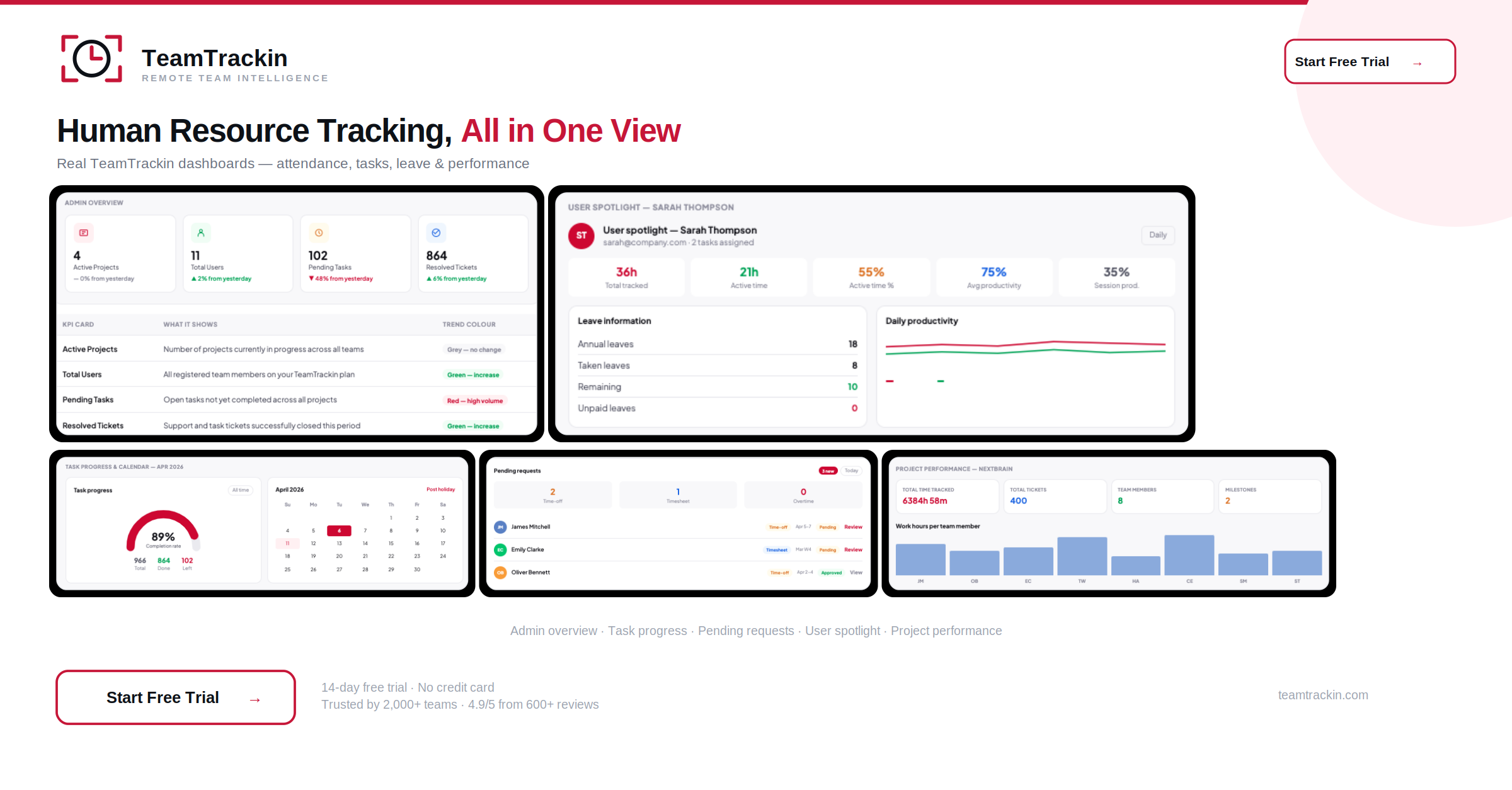
The HR software market hit $76.53 billion in 2026, and 51% of companies now run attendance, records, and compliance through a dedicated system instead of spreadsheets. TeamTrackin is human resource tracking software built around exactly that shift — accurate records, less manual admin, and reporting HR can actually trust.
Human resource tracking is the practice of recording and managing employee data — attendance, hours, leave, and core records — in a centralized digital system instead of spreadsheets or paper files. It's the operational layer most HR and payroll decisions are built on.
TeamTrackin is human resources tracking software that combines attendance, time tracking, leave management, and workforce reporting in one platform — starting at $8 per user per month, with a 14-day free trial and no credit card required.
What Is Human Resource Tracking?
Human resource tracking is the ongoing process of recording employee-related data — attendance, hours worked, leave balances, and core employment records — in a system built to keep that data accurate and accessible, rather than scattered across spreadsheets, email threads, and paper files.
It sounds administrative, and in one sense it is — but it's the administrative layer everything else in HR depends on. Payroll needs accurate hours. Compliance needs accurate records. Performance reviews need accurate attendance and leave history. When tracking is inconsistent, every process built on top of it inherits that inconsistency.
Human resource tracking is recording and managing employee data — attendance, hours, leave, and core records — in a centralized system instead of spreadsheets or paper files. TeamTrackin is human resource tracking software built around this, combining attendance, time tracking, and reporting in one platform.
Why Human Resources Tracking Software Matters More Each Year
The HR payroll and HRMS software market reached $76.53 billion in 2026 and is projected to more than double by 2035 — growth driven less by new features and more by a basic shift: companies no longer treat spreadsheet-based HR as acceptable at scale. 51% of companies now run attendance, compliance, and recordkeeping through dedicated tracking systems.
The reason is straightforward. McKinsey's HR Monitor found that 93% of HR professionals now say employee data genuinely lives inside HR systems, not spreadsheets — meaning the shift away from manual tracking isn't an emerging trend anymore, it's close to the operating default.
Human Resource Tracking Systems vs a Full HRMS
These terms get used interchangeably, but they're not quite the same thing, and the distinction matters when comparing software.
Human resources tracking systems typically focus on a narrower job: attendance, time tracking, and leave management. An HRMS management system is broader by design — it usually adds payroll, benefits administration, recruitment, and workforce planning into the same platform. Neither is universally "better" — a growing company often starts with tracking and adds HRMS-level functionality as its needs get more complex, rather than starting with an enterprise HRMS it doesn't yet need.
6 Features Real Human Resource Tracking Software Needs
Whether you need lightweight tracking or a full HRMS, these six features separate systems that actually get adopted from ones that get quietly abandoned within a year.
Manual HR Records vs a Modern Tracking System
- Attendance and leave tracked in separate, disconnected files
- Records updated manually, prone to version conflicts
- Compliance reports assembled by hand for every audit
- No consistent access control on sensitive HR data
- Payroll built on numbers re-typed from another source
- Attendance, leave, and records live in one connected system
- Updates happen once, reflected everywhere automatically
- Compliance reports generate on demand, audit-ready
- Role-based access keeps sensitive data properly scoped
- Payroll pulls directly from verified tracked data
Replace spreadsheet HR with real tracking.
TeamTrackin centralizes attendance, leave, and records — try it free.
How TeamTrackin Handles Human Resource Tracking
Compliance & Data Security in HR Tracking
Human resource tracking systems hold some of the most sensitive data a company manages, so security isn't optional — it's a baseline requirement.
- Data encryption:Employee records encrypted at rest and in transit
- Role-based access:Sensitive data visible only to authorized roles
- Audit trail:Changes to records logged and traceable
- Regulatory alignment:Support for GDPR and relevant local employment law
TeamTrackin runs on GDPR-friendly architecture with AES-256 encryption and role-based access control, keeping HR data secure by default.
Why Teams Choose TeamTrackin as Their HRMS
Human Resource Tracking Software Compared (2026)
| Feature | TeamTrackin | BambooHR | Zimyo | Gusto |
|---|---|---|---|---|
| Attendance & time tracking | ✓ Included | ~ Add-on | ✓ Included | ~ Add-on |
| Leave & PTO management | ✓ Included | ✓ Included | ✓ Included | ✓ Included |
| Task-level time tracking | ✓ Included | ✗ Not available | ~ Limited | ✗ Not available |
| Entry-level pricing | $8 / user / mo | ~$6.19 / user / mo | ~$2-4 / user / mo | $6 / user / mo + base fee |
Frequently Asked Questions
- What is human resource tracking?
Human resource tracking is the practice of recording and managing employee-related data — attendance, hours, leave, performance, and core records — in a centralized digital system instead of spreadsheets or paper files. It's the operational foundation most HR decisions, from payroll to compliance, are built on.
- What is the difference between human resources tracking software and an HRMS?
Human resources tracking software typically focuses on a narrower set of functions — attendance, time, and leave tracking. An HRMS management system is broader, usually combining tracking with payroll, benefits administration, recruitment, and workforce planning in one platform. Many modern tools blur this line by offering both, but the distinction still matters when comparing software built for one purpose versus software built to run HR end-to-end.
- What should human resources tracking systems include?
Human resources tracking systems should include accurate attendance and time tracking, leave and PTO management, centralized employee records, compliance-ready reporting, and role-based access control. Systems that only track one of these in isolation tend to get replaced within a year or two as a company grows past what a single-purpose tool can handle.
- Is TeamTrackin an HRMS management system?
TeamTrackin combines the core of human resource tracking — attendance, time tracking, leave management, and workforce reporting — with HR automation features in one platform, priced from $8 per user per month. It's built around tracking and workforce visibility specifically, rather than the full recruitment-to-retirement scope of an enterprise HRMS.
- How much does human resource tracking software cost?
Human resource tracking software typically ranges from free, limited-feature plans to $8-15 per user per month for full-featured platforms that include attendance, leave management, and reporting. Full HRMS platforms with payroll and recruitment built in tend to cost more, often with per-module or enterprise pricing.
Human resource tracking
that replaces the spreadsheet.
TeamTrackin centralizes attendance, leave, and records in one platform — try it free for 14 days.
Start Free Trial→14-day free trial · No credit card · Setup in ~3 minutes