
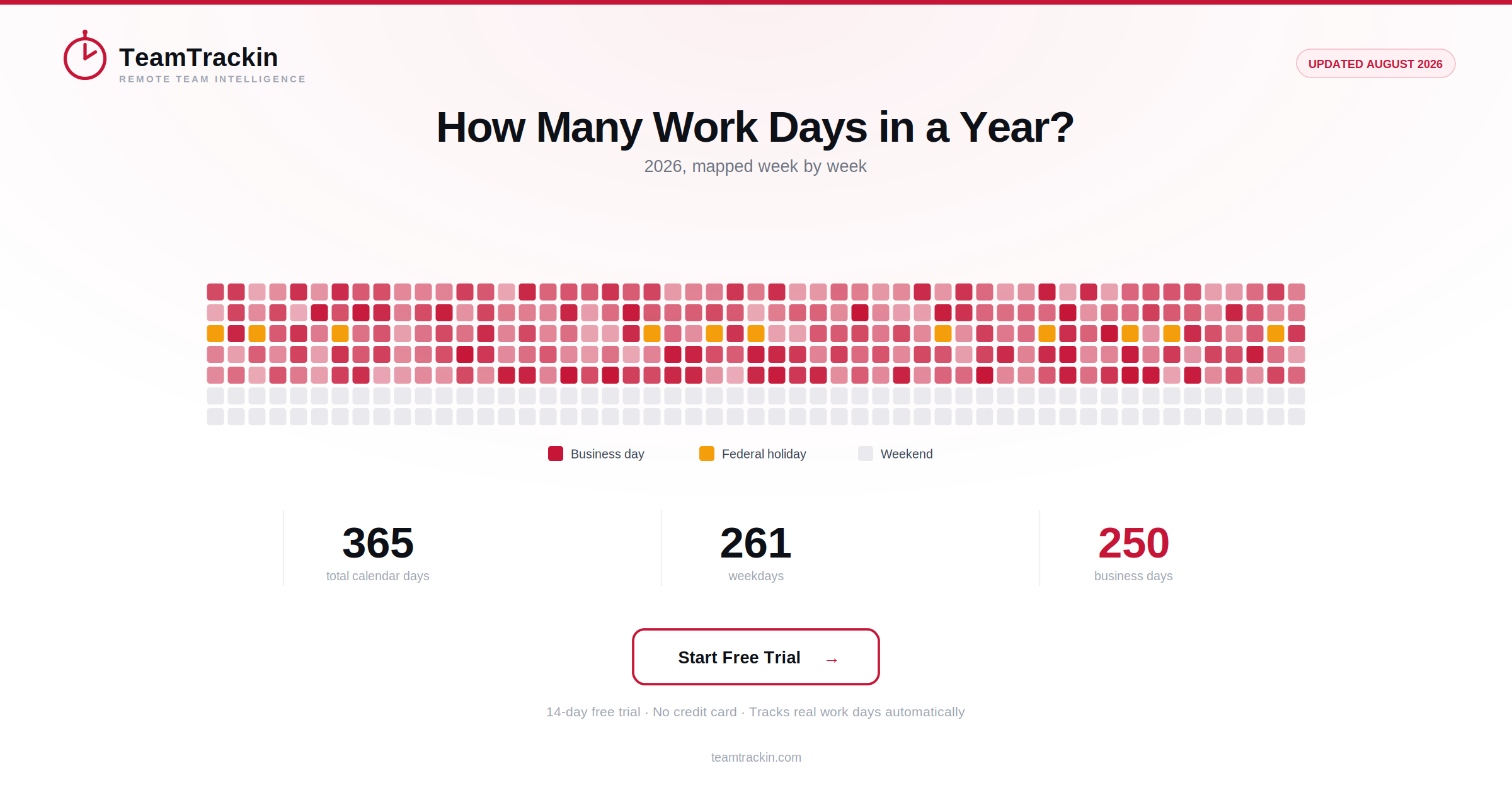
Short answer: 2026 has 261 weekdays and 250 business days once all 11 US federal holidays are excluded. Here's exactly how that number is calculated, the full 2026 holiday list, and why your team's real work-day count is usually lower than the calendar suggests.
2026 has 261 work days if you count every Monday through Friday (weekdays), or 250 business days if you also exclude all 11 US federal holidays — all of which fall on weekdays in 2026.
The formula: 365 calendar days − 104 weekend days = 261 weekdays. Subtract the 11 federal holidays and you get 250 business days. Add typical vacation and sick leave on top of that, and most full-time employees actually work closer to 230–240 days in practice.
How Many Work Days Are in 2026? Quick Answer
For 2026, there are 261 working days if you count every weekday (Monday through Friday) regardless of holidays. If you subtract the 11 US federal holidays — the more practical number for most businesses — 2026 has 250 business days.
Which number is "correct" depends on what you're calculating for. Payroll processing over a fixed number of pay periods often uses 261. Staffing and project planning that account for public holidays typically uses 250.
In 2026, there are 261 weekdays and 250 business days after excluding all 11 US federal holidays. The exact figures shift slightly each year depending on which day of the week January 1 falls on and how many holidays land on weekdays.
How to Calculate Work Days in Any Year
The formula is straightforward once you break it into three steps:
- Step 1 — Start with total calendar days: 365 in a common year, 366 in a leap year.
- Step 2 — Subtract weekends: A year has 52 weeks plus 1–2 extra days, which works out to roughly 104 weekend days most years.
- Step 3 — Subtract holidays: Remove any public or company holidays that fall on a weekday (holidays landing on a weekend don't reduce the weekday count further, unless your organization observes them on the nearest weekday).
For 2026 specifically: 365 − 104 (weekends) − 11 (federal holidays) = 250 business days.
Weekdays vs Business Days vs Work Days
These terms get used interchangeably, but they don't all mean the same thing — and mixing them up is where a lot of scheduling and deadline confusion actually comes from.
Full List: 2026 US Federal Holidays
All 11 federal holidays in 2026 fall on weekdays (including observed dates), so every one of them reduces the working-day count.
| Holiday | 2026 Date | Day |
|---|---|---|
| New Year's Day | January 1 | Thursday |
| Martin Luther King Jr. Day | January 19 | Monday |
| Washington's Birthday (Presidents' Day) | February 16 | Monday |
| Memorial Day | May 25 | Monday |
| Juneteenth | June 19 | Friday |
| Independence Day (observed) | July 3 | Friday (July 4 falls on Saturday) |
| Labor Day | September 7 | Monday |
| Columbus Day | October 12 | Monday |
| Veterans Day | November 11 | Wednesday |
| Thanksgiving Day | November 26 | Thursday |
| Christmas Day | December 25 | Friday |
Source: US Office of Personnel Management (OPM) 2026 federal holiday schedule.
Why Your Real Work-Day Count Is Usually Lower
250 business days is a useful planning number, but it's not what any individual employee actually works. Once you layer in typical paid time off — commonly 10-15 vacation days, a handful of sick days, and the occasional personal day — most full-time employees land closer to 230-240 actual work days in a given year.
This gap matters more than it looks. A project plan built on "250 working days available this year" without accounting for real PTO patterns will consistently run optimistic — not because of bad planning, but because the baseline number was never the achievable one to begin with.
Use 261 or 250 for calendar-level math — payroll periods, contract deadlines, holiday scheduling. Use each employee's actual tracked days for capacity and staffing decisions. Treating the calendar number as a capacity number is where over-scheduling usually starts.
Stop planning on a generic calendar number.
TeamTrackin shows your team's real, tracked work days — try it free.
Why This Number Matters for Staffing & Payroll
Beyond curiosity, "how many work days in a year" is a real input into several business decisions: annualizing a salaried employee's per-day cost, setting realistic project timelines, calculating PTO accrual rates, and forecasting staffing needs around holiday clusters.
Businesses with hourly or shift-based teams feel this even more directly — a scheduling gap of just a few days across a year, multiplied across a whole team, adds up to a meaningful staffing or budget miscalculation if the underlying day count was wrong.
How TeamTrackin Tracks Actual Work Days Automatically
Instead of estimating from a generic calendar formula, TeamTrackin tracks each employee's real work days, hours, holidays, and leave — so staffing and payroll decisions are based on what actually happened, not an average.
Frequently Asked Questions
- How many work days are in a year?
In 2026, there are 261 weekdays (Monday through Friday) out of 365 calendar days. Once all 11 US federal holidays are excluded, there are 250 business days. The exact number shifts slightly year to year depending on which day of the week January 1 falls on and how many holidays land on weekdays versus weekends.
- How many working days in a year 2026?
2026 has 261 working weekdays and 250 business days after subtracting all 11 US federal holidays, all of which fall on weekdays in 2026. If your organization doesn't observe federal holidays, 261 is the more relevant number; if it does, 250 is the practical working-day count.
- How many work days are there in a year, on average?
A typical year has between 260 and 262 weekdays, and between 249 and 251 business days after federal holidays, depending on how the calendar falls that year. Add typical vacation and sick time, and most full-time employees actually work closer to 230-240 days once real paid time off is factored in.
- How many days worked in a year for a part-time employee?
It depends entirely on the schedule. A part-time employee working 3 days a week would work roughly 150-156 days in 2026, while someone working 20 hours over 4 shorter days would land somewhere else again. Unlike the standard full-time calculation, part-time work-day counts have to be based on the individual's actual scheduled days rather than a fixed weekday formula.
- Does TeamTrackin calculate work days automatically?
Yes. TeamTrackin tracks actual days and hours worked per employee automatically, factoring in holidays, approved leave, and each person's real schedule — rather than relying on a generic calendar formula that doesn't reflect what any individual employee actually worked.