
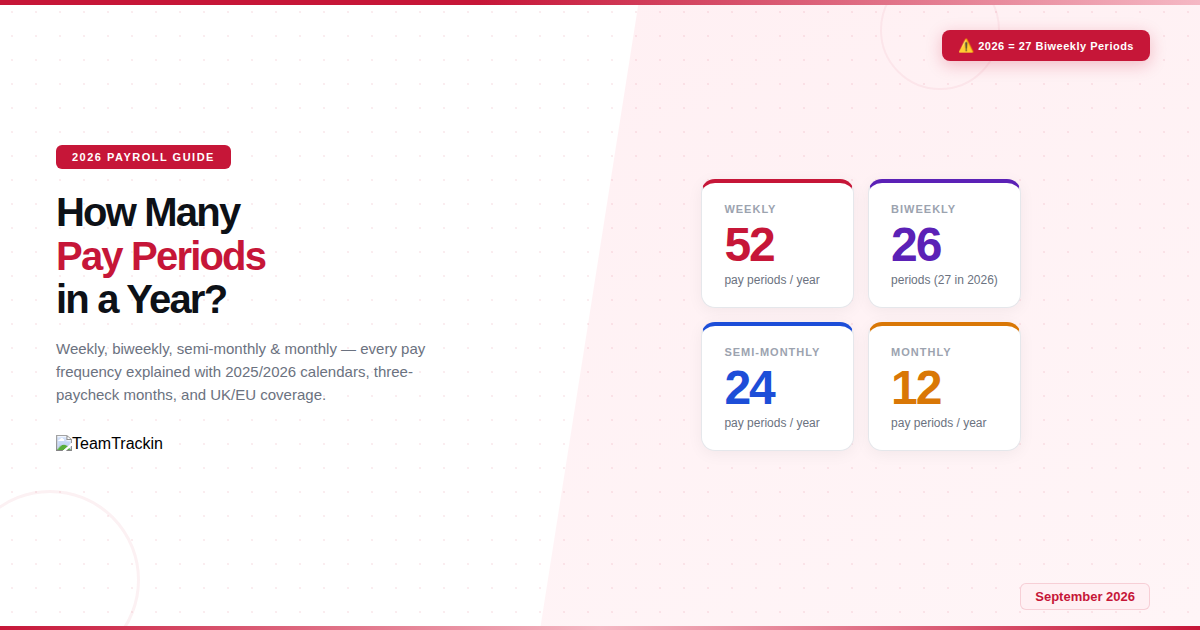
The answer depends on your pay frequency: 52 weekly, 26 biweekly (27 in 2026), 24 semi-monthly, or 12 monthly. But the number alone doesn't tell the whole story — pay periods affect payroll costs, tax withholding, benefits deductions, and cash flow. This guide covers every pay frequency, the 2026 anomaly, three-paycheck months, UK and European pay cycles, and how to track hours accurately for error-free payroll.
The number of pay periods depends on your pay schedule:
Weekly: 52 pay periods (53 in some years) · Biweekly: 26 pay periods (27 in 2026) · Semi-monthly: 24 pay periods (always) · Monthly: 12 pay periods (always)
Biweekly is the most common pay frequency in the US (43% of employers). Monthly is the standard in the UK and most European countries. The key difference: biweekly is based on a fixed day of the week (every other Friday), while semi-monthly is based on fixed calendar dates (1st and 15th). This means biweekly occasionally produces an extra pay period when the calendar aligns — and 2026 is one of those years.
Pay Periods by Frequency: The Complete Comparison
Before diving into specific pay schedules, here's how all four standard pay frequencies compare across the metrics that matter for payroll planning:
| Pay Frequency | Periods Per Year | Period Length | Paycheck Calculation ($60K salary) | Used By (US) |
|---|---|---|---|---|
| Weekly | 52 (53 in some years) | 7 days | $1,153.85 per check | ~31% of employers |
| Biweekly | 26 (27 in some years) | 14 days (80 hours) | $2,307.69 per check | ~43% of employers |
| Semi-monthly | 24 (always) | Varies (13-16 days) | $2,500.00 per check | ~19% of employers |
| Monthly | 12 (always) | 28-31 days | $5,000.00 per check | ~7% of employers |
Notice the paycheck amounts: a $60,000 salary pays $2,307.69 biweekly but $2,500 semi-monthly. That's because the same annual salary is divided by 26 instead of 24 — each biweekly check is smaller, but there are two more of them per year. The annual total is identical; only the per-check amount changes.
Pay frequency directly impacts four things: payroll processing costs (more periods = more processing runs), cash flow management (more frequent pay = more frequent outflows), benefits deductions (health insurance premiums divided across 24 vs 26 checks), and employee satisfaction (hourly workers generally prefer more frequent pay). The FLSA doesn't mandate a specific frequency, but most states require at least semi-monthly pay for most employees.
How Many Biweekly Pay Periods in a Year? (2025 & 2026)
Biweekly pay — every two weeks on the same day — is the most popular pay schedule in the United States, used by approximately 43% of employers. In a standard year, biweekly pay produces 26 pay periods, each covering exactly 14 days (80 hours for a 40-hour work week).
Biweekly pay periods in 2025
For 2025, most companies on a biweekly schedule had 26 pay periods. Whether a specific company had 26 or 27 depended on their payroll start date and which day of the week they process payroll. If your first 2025 biweekly payday was Friday, January 3, 2025, you would have had 26 pay periods ending with the last payday on December 26, 2025.
Biweekly pay periods in 2026
2026 is different. For many employers — particularly those whose biweekly cycle carries over from late 2025 — 2026 will have 27 biweekly pay periods instead of the usual 26. This happens because 2026's calendar alignment creates an extra pay cycle when the year begins or ends on the right day relative to your pay schedule. This occurs roughly every 11 years — the last time was 2015, and the next will be 2037.
⚠️ The 27th period matters for budgets: If your company pays salaried employees a fixed amount per biweekly check (annual salary ÷ 26), a 27th pay period means paying an extra paycheck — potentially thousands of dollars per salaried employee over budget. Companies must decide in advance: divide the annual salary by 27 instead of 26 (smaller checks), or absorb the extra cost. Either way, communicate the plan to employees before January.
Why 2026 Has 27 Biweekly Pay Periods (and What to Do About It)
A calendar year has 365 days (366 in leap years). Dividing 365 by 14 (the length of a biweekly period) gives 26.07 — not a clean 26. That fractional day accumulates over years, and roughly every 11 years, it pushes an extra pay period into the calendar year. 2026 is one of those years for many companies.
The next 27-pay-period years (for biweekly schedules) are projected to be 2026, 2037, and 2048 — though the exact year depends on your specific payroll start date.
How to handle the 27th period
- For salaried employees: Either divide the annual salary by 27 (resulting in slightly smaller per-check amounts) or keep dividing by 26 and budget for the extra paycheck. Most payroll advisors recommend dividing by 27 and communicating the change clearly.
- For hourly employees: No adjustment needed — hourly workers are paid for actual hours worked regardless of how many pay periods exist. Accurate time tracking ensures they're paid correctly for every period.
- For benefits deductions: Health insurance premiums and retirement contributions are typically calculated for 26 deductions. With 27 periods, you may need to adjust the per-check deduction amount or take no deduction from the 27th check.
- For tax withholding: IRS withholding tables are designed for 26 biweekly periods. With 27, per-check withholding may need adjustment to avoid over-withholding for the year.
If your business ran its first 2025 biweekly paycheck on Friday, January 3, 2025, the carryover may push you to 27 periods in 2026. Map out your full 2026 payroll calendar before January to avoid surprises. Your payroll software should flag this automatically — if it doesn't, it's worth checking manually.
Three-Paycheck Months Explained (2026 Biweekly Calendar)
If you're paid biweekly, most months contain exactly two paydays. But two months each year contain three paydays — the so-called "three-paycheck months." These occur because a biweekly schedule produces 26 (or 27) paychecks spread across 12 months — and 26 doesn't divide evenly by 12.
The specific three-paycheck months depend on which day of the week your company pays and when the first payday of the year falls. For a common 2026 biweekly schedule starting Friday, January 2:
| Month | Paydays | Notes |
|---|---|---|
| January 2026 | Jan 2, Jan 16, Jan 30 | 🟢 Three-paycheck month |
| February | Feb 13, Feb 27 | Standard two-paycheck month |
| March | Mar 13, Mar 27 | Standard |
| April | Apr 10, Apr 24 | Standard |
| May | May 8, May 22 | Standard |
| June | Jun 5, Jun 19 | Standard |
| July 2026 | Jul 3, Jul 17, Jul 31 | 🟢 Three-paycheck month |
| August | Aug 14, Aug 28 | Standard |
| September | Sep 11, Sep 25 | Standard |
| October | Oct 9, Oct 23 | Standard |
| November | Nov 6, Nov 20 | Standard |
| December | Dec 4, Dec 18 | Standard |
For employees, three-paycheck months feel like "bonus" months — the extra check isn't really extra money (the annual total is the same), but it provides a cash flow boost that's useful for savings goals, debt payments, or larger purchases. For employers, these months mean higher payroll outflows, so cash flow planning should account for them in advance.
Every pay period starts with accurate hours.
TeamTrackin tracks time automatically and generates payroll-ready timesheets — no manual entry.
Biweekly vs Semi-Monthly Pay: What's the Difference?
These two pay frequencies are frequently confused because they both result in roughly two paychecks per month. But they work very differently — and the distinction matters for payroll processing, overtime calculations, and benefits management.
| Factor | Biweekly | Semi-Monthly |
|---|---|---|
| Schedule basis | Same weekday every 2 weeks (day-based) | Fixed calendar dates, e.g., 1st & 15th (date-based) |
| Pay periods per year | 26 (sometimes 27) | Always 24 |
| Period length | Always exactly 14 days (80 hours) | Varies: 13-16 days depending on the month |
| Per-check amount ($60K) | $2,307.69 | $2,500.00 |
| Three-paycheck months | Yes — 2 months per year | Never |
| Overtime calculation | Simpler — periods align with work weeks | Harder — periods may straddle work weeks |
| Best for | Hourly workers, variable hours, shift-based teams | Salaried employees, monthly budgeting |
The most important practical difference: biweekly periods always contain exactly 80 hours (for a 40-hour work week), making overtime calculation straightforward. Semi-monthly periods cover varying numbers of days, which means overtime hours may need to be reconciled across period boundaries when the pay period doesn't align with the FLSA work week. For teams with significant hourly or overtime work, biweekly is almost always the better choice.
How Many Pay Periods in a Year in the UK and Europe?
Pay frequency varies significantly across countries. While biweekly dominates in the US, monthly pay is the standard in the UK and most of Europe. Here's how pay periods break down globally:
| Country | Most Common Frequency | Periods Per Year | Key Notes |
|---|---|---|---|
| United States | Biweekly (43%) | 26 or 27 | FLSA doesn't mandate frequency; state laws vary |
| United Kingdom | Monthly | 12 | Tax year: 6 April – 5 April. Weekly (52) common in trades, hospitality |
| Germany | Monthly | 12 | Legally mandated monthly pay in most cases |
| France | Monthly | 12 | Monthly is the legal standard for most employees |
| Netherlands | Monthly | 12 | Monthly standard; some sectors use 4-weekly (13 periods) |
| Australia | Monthly or fortnightly | 12 or 26 | Both equally common; fortnightly preferred for hourly workers |
| Canada | Biweekly | 26 | Similar to US; varies by province |
| Ireland | Monthly or fortnightly | 12 or 26 | Both common; monthly more prevalent in professional sectors |
UK pay periods in detail
In the UK, the tax year runs from 6 April to 5 April the following year. Employers submit payroll information to HMRC through the Real Time Information (RTI) system, with a Full Payment Submission (FPS) required on or before each payday. The number of FPS submissions per year depends on the pay frequency:
- Monthly: 12 submissions per year — the most common and lowest administrative burden
- Weekly: 52 submissions (53 in some years) — highest admin, but preferred by hourly workers in hospitality, retail, and construction
- Fortnightly: 26 submissions — a middle ground used in some shift-based industries
- Four-weekly: 13 submissions — consistent 28-day periods, but requires careful planning since it doesn't align with calendar months
UK employers can choose any legally supported frequency, but it must be consistent for each employee unless the contract specifically allows changes. Changing pay frequency requires notifying HMRC to avoid non-filing notices.

TeamTrackin's finance dashboard — showing how tracked hours across pay periods flow directly into payroll calculations, salary breakdowns, and overtime management
How to Choose the Right Pay Frequency for Your Business
The best pay frequency depends on your workforce type, state requirements, administrative capacity, and cash flow. Here's a decision framework:
Hourly / shift-based workforce
Choose weekly or biweekly. Hourly workers prefer frequent pay, and these frequencies align cleanly with work weeks for simple overtime calculations. Biweekly is the sweet spot — frequent enough for employees, manageable for admin.
Salaried / professional workforce
Choose semi-monthly or monthly. Salaried employees don't need overtime alignment, and these schedules align with monthly budgets, benefits cycles, and accounting periods. Semi-monthly is the US standard for salaried; monthly is the UK/European standard.
Mixed workforce (hourly + salaried)
Choose biweekly for everyone. Running a single pay frequency across the company simplifies administration, communication, and payroll processing — even if semi-monthly would be marginally better for the salaried group.
Check state law first
Several US states mandate minimum pay frequency. California and New York require at least semi-monthly for most employees. Always check your state's DOL payday requirements before setting or changing a pay schedule.
Why Accurate Time Tracking Matters for Every Pay Period
Regardless of whether you run 12, 24, 26, or 52 pay periods per year, the accuracy of each payroll depends on one thing: the quality of the time data going in. Manual timesheets — filled from memory at the end of the week — contain errors roughly 80% of the time. Over 26 or 52 pay periods, those errors compound into significant payroll inaccuracies, compliance exposure, and employee trust issues.
Automatic time capture
TeamTrackin logs hours as employees work — no manual timers to start, no end-of-week reconstruction from memory. Every pay period starts with accurate, verifiable hour data.
Payroll-ready exports
Tracked hours flow directly into payroll — overtime calculated automatically, decimal conversions handled, and the data formatted for your pay frequency (weekly, biweekly, or monthly).
Overtime alerts
The system flags when employees approach 40 hours within a work week — preventing surprise overtime costs before they appear on the payroll run.
Timesheet approvals
Managers review and approve timesheets before each pay period closes. One-click approval workflows replace paper chasing and ensure nothing reaches payroll without verification.

TeamTrackin's admin dashboard — the command centre that ensures every pay period starts with accurate, approved time data
Frequently Asked Questions
- How many pay periods in a year?
It depends on the pay frequency: weekly pay has 52 periods (53 in some years), biweekly has 26 (27 in some years like 2026), semi-monthly always has 24, and monthly always has 12. Biweekly is the most common in the US (43% of employers), while monthly is standard in the UK and Europe.
- How many biweekly pay periods in a year?
There are 26 biweekly pay periods in a standard year, and 27 in years when the calendar creates an extra pay cycle (roughly every 11 years). 2026 is a 27-pay-period year for many employers. Each biweekly period covers exactly 14 days or 80 hours for full-time workers.
- How many pay periods in a year biweekly 2025?
In 2025, most companies on a biweekly schedule had 26 pay periods. Whether a specific company had 26 or 27 depended on their payroll start date and which day of the week they process payroll.
- What is the difference between biweekly and semi-monthly pay?
Biweekly pay occurs every 14 days on the same weekday, producing 26 (sometimes 27) periods per year with consistent 80-hour periods. Semi-monthly pay occurs twice per month on fixed calendar dates (like the 1st and 15th), always producing 24 periods per year with varying period lengths. Biweekly is simpler for overtime calculation; semi-monthly aligns better with monthly budgets.
- What are the three-paycheck months in 2026?
For a biweekly schedule starting Friday, January 2, 2026, the three-paycheck months are January and July. The specific months depend on your company's payroll start date. These months are important for budgeting because employees receive an extra paycheck and employers face higher payroll outflows.
- How many pay periods in a year in the UK?
In the UK, monthly pay (12 periods per tax year) is the most common. Weekly pay (52 periods) is used in hospitality, retail, and construction. Fortnightly (26 periods) and four-weekly (13 periods) are also used. The UK tax year runs from 6 April to 5 April, and employers submit payroll to HMRC via RTI on or before each payday.
External sources: Pay frequency statistics sourced from Bureau of Labor Statistics employer data. State payday requirements available at DOL State Payday Requirements. All data verified as of September 2026.
26, 27, or 52 pay periods.
Every one starts with accurate hours.
TeamTrackin automatically tracks hours, generates payroll-ready timesheets, and calculates overtime — so every pay period is accurate from day one.
Start Free Trial→14-day free trial · No credit card · Setup in ~3 minutes