
There's no single universal answer — part-time hours depend on your employer, your country, and which government agency is asking. Here's the complete breakdown of every definition that matters, how part-time compares to full-time, and what rights part-time workers actually have.
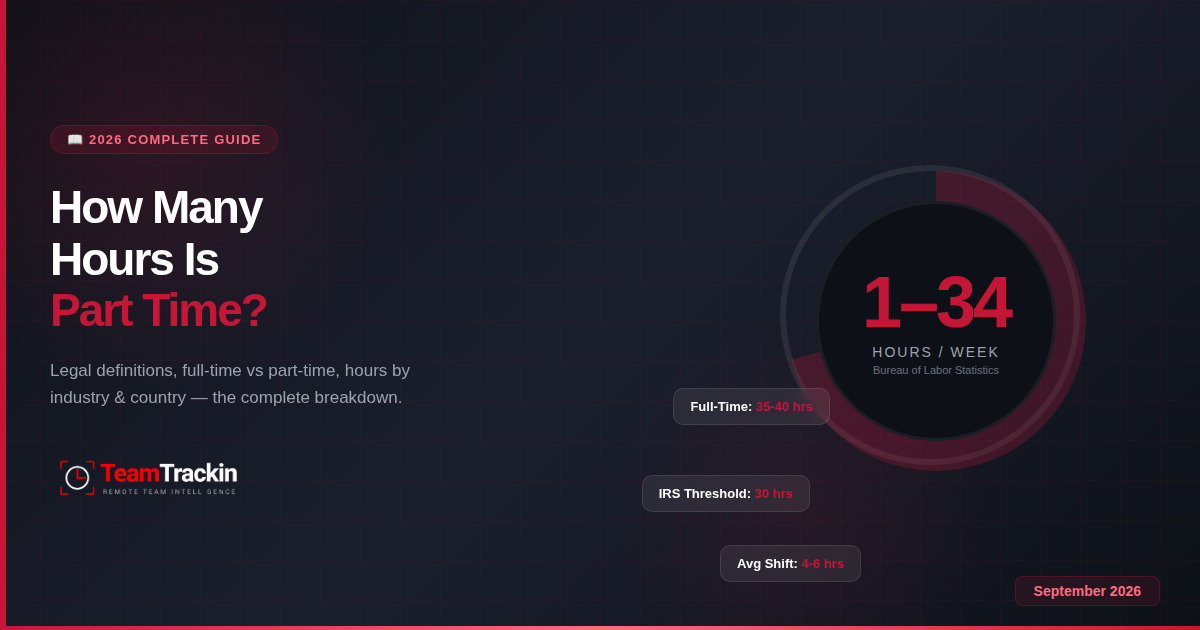
Part-time work typically means 1 to 34 hours per week, according to the U.S. Bureau of Labor Statistics. Most employers define part-time as anything under 30 to 35 hours weekly. The IRS and ACA set the line at 30 hours per week (or 130 hours per month) — anyone below that threshold is part-time for health insurance and benefits purposes.
However, there is no single federal law that defines "part-time." The Fair Labor Standards Act (FLSA) does not distinguish between part-time and full-time workers at all. This means the exact number of hours depends on your employer's policy, your industry, and your country.
Legal Definitions of Part-Time Hours: FLSA, IRS, ACA & BLS
One of the biggest sources of confusion around part-time hours is that different government agencies use different definitions. None of them agree on a single number, and the most important labour law in the United States — the FLSA — doesn't define part-time at all. Here's how each agency handles it:
Fair Labor Standards Act (FLSA)
The FLSA sets minimum wage, overtime, and recordkeeping standards — but it does not define part-time or full-time employment. It leaves that distinction entirely to employers. However, all FLSA protections (minimum wage, overtime after 40 hours) apply equally to both part-time and full-time workers.
IRS / Affordable Care Act
For health insurance purposes, the IRS defines full-time as 30+ hours per week or 130+ hours per month. Anyone below that threshold is part-time. This matters because employers with 50+ FTE employees must offer health coverage to full-time staff — and the 30-hour line determines who qualifies.
Bureau of Labor Statistics (BLS)
The BLS classifies anyone working 1 to 34 hours per week as part-time for statistical purposes. This is the most commonly cited range when people ask "how many hours is part time" — but it's a benchmark for labour research, not a legal requirement for employers.
Employer Policy
Since federal law doesn't define part-time, most employers set their own threshold — typically 20 to 29 hours per week. This number is usually documented in the employee handbook and determines benefits eligibility, scheduling, and pay structure within that company.
There is no single legal answer to "how many hours is part time." The BLS says 1-34 hours. The IRS/ACA says under 30 hours. Your employer may use a different number entirely. The definition that matters most depends on what you're trying to determine — statistical classification, health insurance eligibility, or company benefits.
Full-Time vs Part-Time: The Complete Comparison
Understanding the difference between full-time and part-time employment goes beyond just counting hours. The classification affects benefits, compensation structure, legal protections, and career trajectory. Here's how the two compare across every dimension that matters:
| Factor | Part-Time | Full-Time |
|---|---|---|
| Hours per week | 1–34 hours (BLS) / under 30 (IRS) | 35–40+ hours |
| Average shift length | 4–6 hours per day | 8 hours per day |
| Compensation | Hourly wage | Salary or hourly wage + potential bonuses |
| Health insurance | Usually not required (under ACA threshold) | Required for ALEs under the ACA |
| Paid time off | Limited or prorated; depends on employer/state | Comprehensive PTO packages |
| Retirement plans | Eligible at 500+ hours/year (SECURE 2.0 Act) | Eligible at 1,000+ hours/year (ERISA) |
| Overtime eligibility | Yes — same as full-time (FLSA) | Yes, for non-exempt employees |
| Schedule flexibility | High — variable or fixed part-time schedules | Lower — typically fixed 9-to-5 or shift-based |
| Job stability | Lower — often first to have hours reduced | Higher — more investment from employer |
| Career development | Limited training/advancement opportunities | Full access to promotions and development |
Misclassifying employees — calling someone "part-time" when they regularly work 30+ hours — creates serious compliance risk under the ACA. Employers who consistently schedule "part-time" workers for full-time hours may owe back benefits, face IRS penalties, and encounter potential lawsuits. The classification should match the actual hours worked, not just what the job title says.
How Many Hours Is a Part-Time Job? (By Industry)
Part-time hours aren't uniform across industries. A part-time retail worker and a part-time consultant may work very different schedules. Here's how part-time hours typically break down by sector:
| Industry | Typical Part-Time Hours | Common Schedule |
|---|---|---|
| Retail | 15–25 hours/week | Varied shifts, weekends common |
| Hospitality & Food Service | 15–28 hours/week | Evenings, weekends, split shifts |
| Healthcare | 20–30 hours/week | Fixed shifts (e.g., 3 days × 8 hours) |
| Education | 15–25 hours/week | Mornings or afternoons, term-time only |
| Technology / SaaS | 20–30 hours/week | Flexible, often remote |
| Administrative / Office | 20–29 hours/week | Fixed morning or afternoon blocks |
| Construction / Trades | 20–30 hours/week | Project-based, variable |
| Freelance / Consulting | 10–25 hours/week | Self-directed, project-based |
Retail and hospitality consistently have the lowest average part-time hours because of the shift-based nature of the work. Technology and healthcare tend toward the higher end of part-time because the roles often require deeper engagement, even on a reduced schedule.
Need to track part-time and full-time hours accurately?
TeamTrackin automates time tracking, timesheets, and payroll for your entire workforce.
How Many Hours Is Part Time? (By Country)
Part-time definitions vary significantly around the world. What counts as part-time in the United States may be classified differently in the UK, Europe, or Australia. Here's a global comparison:
| Country | Part-Time Definition | Key Legal Framework |
|---|---|---|
| United States | Under 30–35 hours/week | No federal definition; ACA uses 30 hours; BLS uses 1-34 hours |
| United Kingdom | Under 35 hours/week | Part-Time Workers Regulations 2000 — equal treatment required |
| European Union | Under 35 hours/week (varies by member state) | EU Part-Time Work Directive — prohibits discrimination against part-time workers |
| Australia | Under 38 hours/week | Fair Work Act 2009 — part-timers get same hourly rate + pro-rata benefits |
| Canada | Under 30 hours/week | Varies by province; no single federal standard |
| Germany | Under 30 hours/week | Part-Time and Fixed-Term Employment Act — right to request part-time |
| Japan | Under 35 hours/week | Part-Time Employment Act — proportional treatment requirements |
UK-specific note: The UK does not set a specific number of hours for part-time work. Under the Part-Time Workers Regulations 2000, a part-time worker is simply anyone who works fewer hours than a comparable full-time colleague at the same employer. UK part-time workers are legally entitled to the same hourly pay rate, holiday entitlement (on a pro-rata basis), and access to workplace pensions as full-time staff.
Common Part-Time Hour Thresholds and Why They Matter
Three specific numbers appear repeatedly in employer policies and compliance regulations. Each carries different implications for benefits, insurance, and legal obligations:
The 29-hour threshold is particularly risky for employers. If a "part-time" employee regularly works even one hour over that limit, they may average 30+ hours over an ACA measurement period and trigger full-time classification — along with the health insurance obligations that come with it. This is why accurate time tracking matters enormously for businesses managing a mixed workforce of part-time and full-time employees.
Part-Time Employee Rights and Benefits
A common misconception is that part-time workers have fewer workplace rights than full-time employees. In reality, most core legal protections apply equally regardless of hours worked. Here's what part-time workers are entitled to:
Rights that apply to ALL employees (part-time included)
- Minimum wage: Part-time workers must receive at least the federal, state, or local minimum wage — whichever is highest.
- Overtime pay: Non-exempt part-time workers earn 1.5x their regular rate for any hours exceeding 40 in a workweek under the FLSA.
- Anti-discrimination protections: The EEOC protects part-time workers from discrimination based on age, race, gender, disability, and other protected classes.
- Workplace safety: OSHA standards apply regardless of employment status or hours worked.
- Workers' compensation: Part-time employees are covered for workplace injuries in all states.
Benefits that vary by employer and state
- Health insurance: Not required for part-time workers under the ACA (under 30 hours/week). Some employers offer it voluntarily.
- Paid sick leave: Required in many states (California, New York, Washington, and others) for all workers, including part-time — typically accruing at 1 hour per 30 hours worked.
- Paid time off (PTO): No federal requirement. Some employers prorate PTO for part-time staff (e.g., half the PTO for half the hours).
- Retirement plans: Under ERISA, employees working 1,000+ hours/year must be included. The SECURE 2.0 Act now requires 401(k) access for employees working 500+ hours for two consecutive years.
- Holiday pay: Not required by federal law. Some employers pay it voluntarily or based on state mandates.
Before the SECURE 2.0 Act, many long-term part-time workers were excluded from employer retirement plans entirely. Now, employees working at least 500 hours per year for two consecutive years must be allowed to make elective deferrals to their employer's 401(k). This is a significant expansion of retirement access for the 27 million+ Americans working part-time.
How to Track Part-Time Hours Accurately (and Why It Matters)
Accurate time tracking isn't just an administrative convenience — it's a compliance necessity. When part-time hours aren't tracked properly, businesses face real risks: ACA penalties for misclassified employees, overtime violations, incorrect payroll, and disputes over benefits eligibility. The difference between a part-time worker averaging 29 hours and one averaging 31 hours can mean thousands of pounds or dollars in health insurance obligations.
This is where dedicated time tracking software replaces guesswork with data. Instead of relying on manual timesheets (which are frequently inaccurate and easy to manipulate), automated tools record actual hours worked, flag when employees approach compliance thresholds, and generate payroll-ready reports.
Automatic time tracking
Hours are recorded as employees work — no manual timers to start, forget, or inflate. Every minute is logged accurately for both part-time and full-time staff.
Productivity monitoring
See how part-time hours are actually spent — active time, idle time, and productivity scores help ensure that limited hours deliver maximum value.
Payroll automation
Tracked hours flow directly into payroll calculations. Part-time and full-time employees are handled correctly, including overtime calculations when part-timers exceed 40 hours.
Timesheet approvals
Managers review and approve timesheets before payroll runs, catching errors and ensuring part-time workers are logged at the correct number of hours.
Workforce analytics
Reports show hours worked by employee, role, and project — making it easy to spot when part-time employees are creeping toward full-time thresholds.
Compliance-ready data
All time data is stored securely and available for audits, ACA measurement periods, and benefits eligibility reviews — no spreadsheets required.
Frequently Asked Questions
- How many hours is part time?
Part-time work typically ranges from 1 to 34 hours per week, according to the U.S. Bureau of Labor Statistics. Most employers define part-time as anything under 30-35 hours per week. The IRS and ACA use 30 hours per week (or 130 hours per month) as the threshold — anyone working fewer hours than that is considered part-time for health insurance purposes.
- How many hours a week is a part-time job?
A part-time job is typically 15 to 29 hours per week, though this varies by employer. Retail and hospitality roles often average 15-25 hours, while part-time office or professional positions may run 20-30 hours. The key legal threshold is 30 hours per week — the point at which the ACA considers an employee full-time for health coverage purposes.
- What is the difference between full time and part time?
Full-time employees typically work 35-40 hours per week with comprehensive benefits including health insurance, paid time off, and retirement plans. Part-time employees work fewer than 30-35 hours per week, usually receive limited or no benefits, are paid hourly, and have more flexible schedules. The FLSA does not legally define either term — most definitions come from employer policy, the IRS (30-hour threshold), or state law.
- Do part-time workers get overtime pay?
Yes. Under the FLSA, all non-exempt employees — including part-time workers — are entitled to overtime pay at 1.5 times their regular rate for any hours worked over 40 in a single workweek. Some states like California also require daily overtime after 8 hours in a single day, regardless of weekly totals.
- How many hours is part time in the UK?
In the UK, there is no specific number defining part-time hours. Under the Part-Time Workers Regulations 2000, a part-time worker is anyone who works fewer hours than a comparable full-time worker at the same employer. Since full-time in the UK typically means 35-40 hours per week, part-time usually falls under 35 hours. UK part-time workers are legally entitled to the same hourly pay rate, holidays (pro-rata), and workplace rights as full-time employees.
- Can a part-time employee work 40 hours?
A part-time employee can occasionally work 40 hours in a week, but if this happens regularly, the employer may need to reclassify them as full-time. Under the ACA, employers use measurement periods to determine if employees average 30+ hours per week over time. Consistently scheduling a "part-time" worker for 40 hours creates compliance risks and potential liability for benefits the employee should have received.
External sources: Legal definitions and statistics referenced in this article are sourced from the U.S. Department of Labor (FLSA) and the Bureau of Labor Statistics. All information was verified as of September 2026.
Track every hour.
Part-time. Full-time. Overtime.
TeamTrackin automatically tracks hours for your entire workforce — with payroll-ready timesheets, productivity insights, and compliance data built in.
Start Free Trial→14-day free trial · No credit card · Setup in ~3 minutes