
There are 168 hours in every week. That's a mathematical constant — 24 hours × 7 days. But how those 168 hours get divided between work, sleep, commuting, and everything else varies enormously. Here's the complete breakdown — from the simple maths to working hours by country, the 4-day work week movement, and how to reclaim the hours you're losing.
There are 168 hours in a week. That's 24 hours per day multiplied by 7 days. In minutes, that's 10,080 minutes. In seconds, 604,800 seconds. This number never changes — it's the same every week of every year, everywhere in the world.
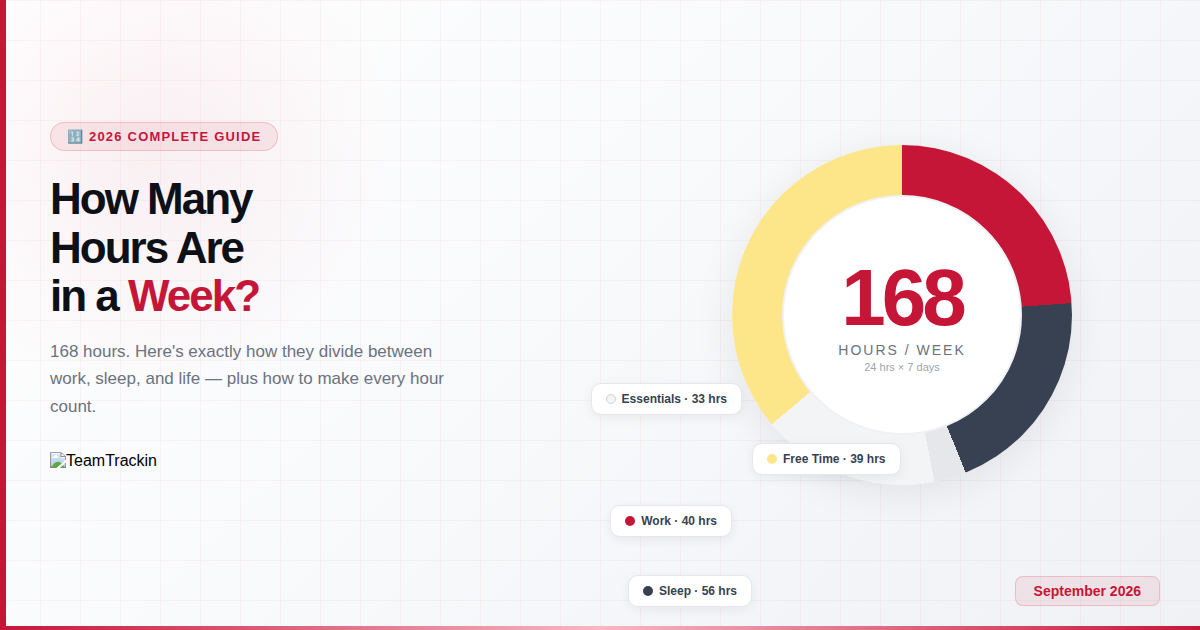
A standard work week is 40 hours (8 hours × 5 days), though the average American actually works 34.3 hours per week as of July 2026. After subtracting sleep (56 hours) and work (40 hours), you have 72 hours of personal time — roughly 10 hours per day — though commuting, errands, and responsibilities consume a significant portion of that.
Hours, Minutes, and Seconds in a Week — The Complete Conversion
Let's start with the simple arithmetic and then build outward. Every time unit in a week derives from one base fact: there are 24 hours in a day and 7 days in a week.
| Time Unit | Amount Per Week | Calculation |
|---|---|---|
| Hours | 168 | 24 hours × 7 days |
| Minutes | 10,080 | 168 hours × 60 minutes |
| Seconds | 604,800 | 10,080 minutes × 60 seconds |
| Working hours (standard) | 40 | 8 hours × 5 days |
| Working hours (actual US avg.) | 34.3 | BLS July 2026 data |
| Sleep hours (recommended) | 56 | 8 hours × 7 nights |
| Remaining personal hours | 72 | 168 − 40 (work) − 56 (sleep) |
That final number — 72 hours of personal time per week, assuming a standard 40-hour work week and recommended sleep — sounds generous. But once you subtract commuting (averaging 4.5 hours per week for the typical American), meal preparation, household chores, errands, and personal hygiene, the actual discretionary time shrinks considerably. Most estimates put genuine "free time" at 25 to 35 hours per week for a working adult.
How 168 Hours Actually Break Down (for the Average Person)
The 168 hours in your week aren't a blank slate — they're pre-committed to a remarkable degree before you make any conscious choices. Here's how the average working adult's week divides, based on time-use research:
That "essentials" category covers meal preparation, eating, personal hygiene, household chores, childcare, errands, and healthcare — the non-negotiable maintenance that keeps life functioning. The 39.5 hours of free time sounds reasonable, but studies consistently show that people perceive having far less free time than they actually have. The reason: fragmentation. Free time scattered in 20-minute pockets between obligations feels like no free time at all, even when the total adds up.
When people say "I don't have time," they rarely mean it literally. They have 168 hours — the same as everyone else. What they mean is "that activity isn't a priority given my current commitments." This reframing, popularised by time management author Laura Vanderkam, shifts the conversation from scarcity to allocation. You don't need more hours — you need better visibility into how the hours you have are actually being spent.
How Many Hours Are in a Work Week?
The "standard" work week is 40 hours — 8 hours per day across 5 weekdays. But the actual number of hours people work varies significantly depending on employment status, industry, country, and individual circumstances.
The standard vs the reality
The Bureau of Labor Statistics reports that as of July 2026, the average work week for all employees on private nonfarm payrolls in the United States was 34.3 hours. This figure includes part-time workers, which pulls the average down. Full-time workers specifically average approximately 38.6 hours per week. The number has remained remarkably stable over the past decade — hovering between 34.2 and 34.8 hours — with dips during economic downturns and a brief spike during the COVID-19 pandemic recovery.
Working hours by industry (US, 2026)
| Industry | Avg Hours/Week (2026) | Notes |
|---|---|---|
| Mining & Logging | 45.6 | Longest hours — remote site shifts, 12-hour days common |
| Manufacturing | 40.1 | Includes 3.0 overtime hours on average |
| Construction | 39.3 | Seasonal variation, longer hours in summer |
| Financial Activities | 37.5 | Standard office hours, minimal overtime |
| Professional & Business Services | 36.4 | Mix of full-time and contract workers |
| Education & Health | 33.1 | High proportion of part-time roles |
| Retail Trade | 30.2 | Predominantly part-time and shift-based |
| Leisure & Hospitality | 25.5 | Shortest hours — heavy part-time, seasonal work |
The 20-hour gap between mining (45.6 hours) and hospitality (25.5 hours) illustrates why "how many hours are in a work week" has no single answer. The industry you work in determines your weekly hours almost as much as whether you're full-time or part-time.
Know exactly where your team's hours go.
TeamTrackin tracks every hour automatically — no manual timers, no guesswork.
How Many Hours Are in a Working Week? (By Country, 2026)
Working hours vary dramatically across countries — shaped by culture, regulation, economic development, and labour law. Here's how average working hours compare globally:
| Country | Avg Weekly Hours | Annual Hours (OECD) | Key Regulation |
|---|---|---|---|
| Mexico | ~42.5 | 2,207 | Highest in OECD. Recent reforms reducing to 40-hour cap. |
| United States | 34.3 (all) / 38.6 (FT) | 1,796 | No legal weekly cap. FLSA requires overtime after 40 hrs. |
| United Kingdom | ~36.4 | ~1,700 | 48-hour weekly cap (Working Time Regulations), opt-out available. |
| Japan | ~36.6 | 1,626 | Legal 40-hour week. Overtime caps often exceeded in practice. |
| Australia | ~36 | 1,694 | 38-hour standard week under Fair Work Act. |
| France | ~35.9 | 1,500 | Legal 35-hour week since 2000. |
| Netherlands | ~32 | 1,417 | World's shortest average. High part-time employment rate. |
| Germany | ~34.2 | 1,343 | Lowest annual OECD hours. Highest GDP per hour in Europe. |
Germany works the fewest annual hours in the OECD (1,343) yet has one of Europe's strongest economies. Ireland and Luxembourg work 34-35 hours per week but achieve the world's highest GDP per hour ($164.7 and $159.5 respectively). Meanwhile, Colombia works 2,400 annual hours with far lower output per hour. The data consistently shows that more hours do not equal more output — Stanford research found productivity drops sharply after 49 hours per week and becomes nearly negligible at 55+ hours.
The Productive Hours Problem: How Many Hours Actually Count?
Of the 168 hours in your week, the hours that generate economic value or meaningful output are a surprisingly small fraction. Research paints a sobering picture of how work hours are actually spent:
2 hours 53 minutes
The average office worker's genuinely productive time per 8-hour day. That's about 14.4 hours of real output in a 40-hour work week — less than 9% of your total 168 hours.
28% on email
The average knowledge worker spends roughly 11 hours per week reading and responding to email — nearly a third of a standard work week consumed by inbox management.
5+ hours in meetings
Meetings have doubled since 2019, consuming roughly 5 hours per week for the average employee. Studies estimate that at least half of these meetings could be emails or async updates.
23 min to refocus
After every interruption or context switch, it takes an average of 23 minutes to return to full focus on the original task. In an open office, interruptions happen every 11 minutes on average.
This means that of the 40 hours in a standard work week, roughly 25 hours are consumed by communication overhead, meetings, context switching, and administrative tasks — leaving only about 15 hours for the focused, productive work that actually moves projects forward. For freelancers, the picture is somewhat better: they average roughly 36 productive hours per week, likely because they have more control over their schedules and fewer meetings.
The visibility gap: Most people have no idea that they're only productive for 15 of their 40 work hours. Without data, the lost time is invisible — it just feels like "being busy." This is exactly what time tracking and productivity monitoring tools solve: they make the gap between hours worked and hours productive visible, quantifiable, and actionable.
The 4-Day Work Week: From 40 Hours to 32
If the average worker is only truly productive for about 15 hours in a 40-hour week, it raises an obvious question: do we need 40 hours at all? The 4-day work week movement is built on this insight, and the data from global trials is remarkably consistent.
What the trials show
A landmark study published in Nature Human Behaviour in July 2025 — covering 2,896 employees across 141 companies in six countries — found that a six-month trial of reduced hours at full pay produced measurable improvements in burnout, job satisfaction, and mental health without harming business performance. Roughly 90% of participating companies continued the 4-day model after the trial.
The UK pilot programme, involving 61 companies and approximately 2,900 employees, saw 92% of companies keep the shorter schedule. Employee burnout dropped 71%, staff turnover fell 57%, and revenue stayed broadly consistent (up 1.4% on average). Iceland's trials, which started as early as 2015, have led to 86% of the country's workforce now having access to shorter hours or actively working them — with no measurable economic harm.
A true 4-day work week means 32 hours at full pay — the "100-80-100" model (100% pay, 80% time, 100% productivity). This is fundamentally different from a compressed schedule that packs 40 hours into 4 longer days (10 hours each). Research shows the 32-hour model delivers better results because it actually reduces total work time, whereas compressed schedules often just create four exhausting days instead of five manageable ones.
How to Reclaim Your 168 Hours (and Make Every Work Hour Count)
Knowing there are 168 hours in a week is the easy part. The hard part is ensuring the 34-40 hours you spend working deliver maximum value — for your business, your team, and your own career. This is where visibility tools replace guesswork with data.
Track where hours actually go
TeamTrackin's automatic time tracking records hours silently — no manual timers to forget. See exactly how time divides across projects, clients, and tasks so you can identify where hours are being lost.
Measure productive vs idle time
Productivity scores and activity monitoring show active work time versus idle periods — making the gap between "hours at desk" and "hours producing" visible and actionable for managers and employees alike.
Align hours with projects
Kanban boards, sprints, and milestones ensure every tracked hour connects to a specific project or goal. No more "where did the week go?" — the data shows exactly where it went.
Convert hours into payroll
Tracked hours flow directly into payroll and invoicing. Part-time, full-time, and overtime calculations happen automatically — no spreadsheets, no manual calculations, no errors.
Catch overwork early
Overtime alerts and workload analytics identify when employees are consistently exceeding healthy weekly hours — the early warning system that prevents burnout before it happens.
GDPR-compliant transparency
Ethical monitoring means employees see their own data. It's transparency, not surveillance — which builds the trust that engagement depends on.
Frequently Asked Questions
- How many hours are in a week?
There are exactly 168 hours in a week. This is calculated by multiplying 24 hours per day by 7 days per week (24 × 7 = 168). Every person on earth gets the same 168 hours — the difference is how those hours are allocated between work, sleep, commuting, personal time, and everything else.
- How many hours are in a work week?
A standard full-time work week is 40 hours (8 hours per day, 5 days per week). However, the actual average across all U.S. employees (including part-time) is 34.3 hours per week as of July 2026, according to the Bureau of Labor Statistics. Full-time workers specifically average about 38.6 hours per week. The FLSA does not define a standard work week length — it only requires overtime pay after 40 hours.
- How many hours are in a working week in the UK?
The standard working week in the UK is typically 37.5 to 40 hours, though there is no single legal definition. The UK Working Time Regulations cap the average working week at 48 hours (calculated over 17 weeks), unless the employee opts out in writing. The average actual hours worked in the UK is approximately 36.4 hours per week for full-time employees.
- How many minutes and seconds are in a week?
There are 10,080 minutes in a week (168 hours × 60 minutes) and 604,800 seconds in a week (10,080 minutes × 60 seconds). These numbers are constant regardless of timezone, location, or time of year.
- Is a 4-day work week 32 hours?
A true 4-day work week is typically 32 hours (8 hours × 4 days) at full pay — following the 100-80-100 model (100% pay, 80% time, 100% productivity). This is different from a compressed work week, which packs the standard 40 hours into 4 longer days (10 hours each). The 32-hour model has shown better results in trials, with 90% of companies in a 2025 Nature study continuing after the trial period.
- How many productive hours are there in a work week?
Research suggests the average office worker is genuinely productive for approximately 2 hours and 53 minutes per day — roughly 14.5 hours in a 5-day work week. The remaining hours are consumed by meetings, email, context switching, and non-productive activities. This is why time tracking and productivity monitoring matter: they make the gap between hours worked and hours productive visible and actionable.
External sources: Working hours data referenced in this article is sourced from the U.S. Bureau of Labor Statistics and OECD working hours data. All statistics verified as of September 2026.
168 hours. 40 at work.
Make every one of them count.
TeamTrackin automatically tracks where your team's hours go — with productivity insights, project management, and payroll built in.
Start Free Trial→14-day free trial · No credit card · Setup in ~3 minutes