
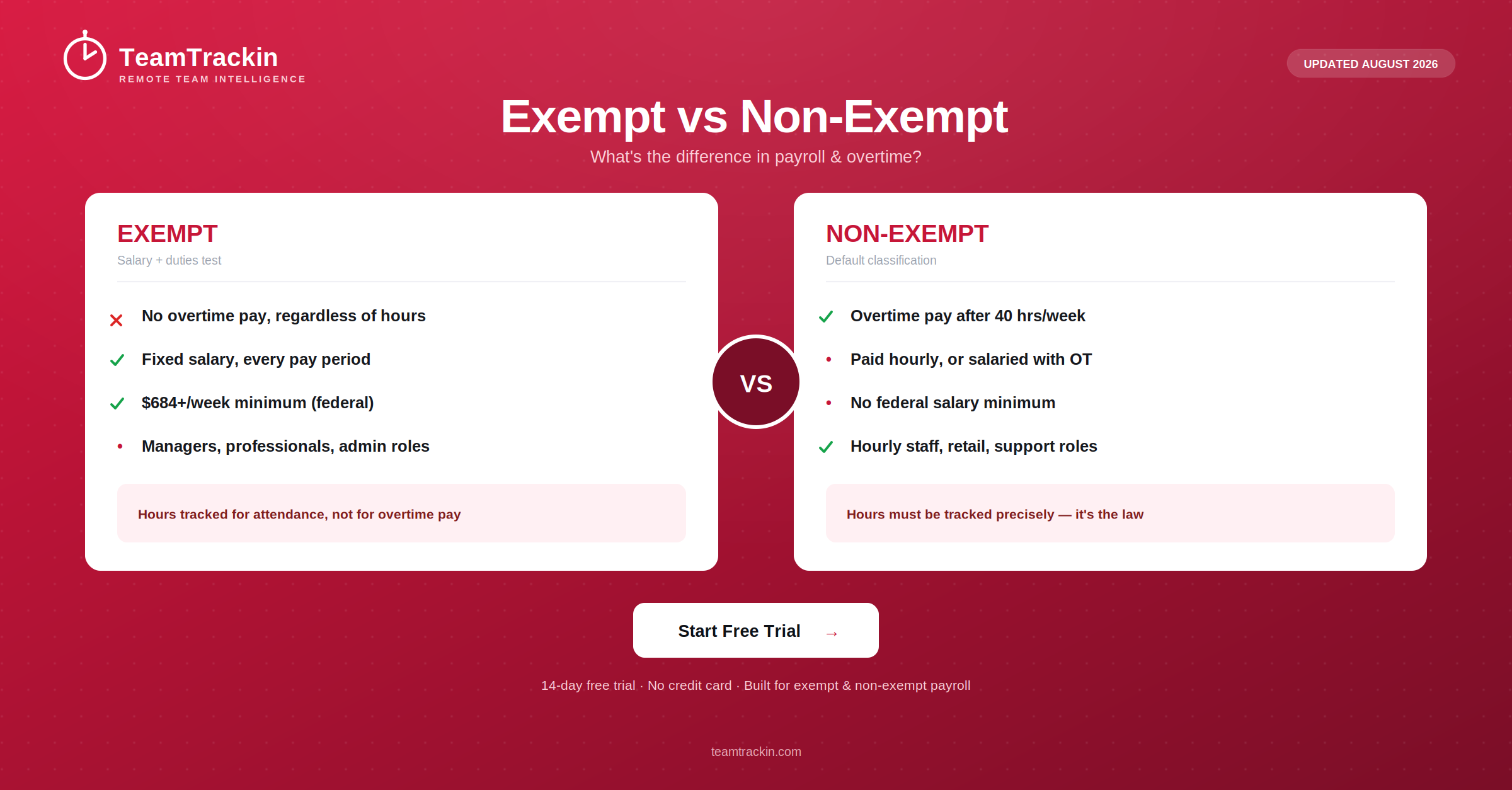
A fixed salary doesn't automatically make someone exempt — and a lot of businesses get this wrong. Here's the actual 3-part test the Department of Labor uses, a shareable side-by-side comparison, and how TeamTrackin handles payroll-ready tracking correctly for both classifications.
Exempt vs non exempt describes whether an employee is legally entitled to overtime pay. Non-exempt employees must be paid 1.5x their regular rate for hours worked over 40 in a week. Exempt employees are excluded from overtime — but only if they meet all three parts of the FLSA test: paid a fixed salary, paid at or above the required threshold ($684/week federally, higher in several states), and performing duties that qualify for an exemption.
Job title and a salary alone don't make someone exempt — the duties test is what most misclassification cases actually turn on.
Exempt vs Non Exempt Employee: The Core Difference
Every US employee falls into one of two categories under the Fair Labor Standards Act: exempt or non-exempt. The label determines one thing above all else — whether that person is legally entitled to overtime pay for hours worked beyond 40 in a week.
Non-exempt employees are covered by the FLSA's overtime protections by default. Exempt employees are carved out of those protections, but only when they satisfy a specific legal test — not simply because they're paid a salary or hold a manager-sounding title.
Exempt vs non exempt determines overtime eligibility under the FLSA. Non-exempt employees must receive overtime pay for hours over 40 in a week. Exempt employees don't receive overtime, but only if they meet the federal salary threshold and duties test — a salary alone doesn't create exempt status.
What Makes an Employee Exempt?
To be classified exempt under federal law, an employee generally has to pass all three of these tests:
- Salary basis test: Paid a fixed, predetermined amount each pay period, not reduced based on hours or quality of work.
- Salary level test: Paid at or above $684 per week ($35,568/year) federally — though at least six states set higher minimums in 2026, including Washington ($1,541.70/week) and others with their own thresholds.
- Duties test: Primary job duties fall into an exempt category — commonly executive, administrative, professional, computer, or outside sales roles — based on actual responsibilities, not job title.
Miss any one of the three, and the employee is non-exempt by default, regardless of salary or title.
What Is a Non-Exempt Employee?
A non-exempt employee is anyone who doesn't meet all three exemption tests — which, in practice, is most hourly workers and a large share of salaried employees below the salary threshold or outside a qualifying duties category. Non-exempt employees must be paid at least minimum wage for all hours worked and overtime (typically 1.5x their regular rate) for anything beyond 40 hours in a workweek.
Because pay is directly tied to hours worked, accurate time tracking isn't optional for non-exempt staff — it's the record that overtime calculations, and legal compliance, actually depend on.
Exempt vs Non-Exempt: Side-by-Side Comparison
A quick reference for exempt vs non-exempt workers — save or share this table with your team.
| Aspect | Exempt | Non-Exempt |
|---|---|---|
| Overtime pay | ✗ Not entitled | ✓ Required over 40 hrs/week |
| Pay structure | Fixed salary | Hourly, or salary with OT tracking |
| Minimum salary (federal) | $684/week ($35,568/yr) | No federal salary minimum — minimum wage applies |
| Hours tracking for pay | Not required for pay purposes | ✓ Required and legally mandated |
| Common roles | Managers, professionals, some admin roles | Hourly staff, retail, support, many admin roles |
| Pay docking rules | Tightly restricted (salary-basis rule) | Paid only for hours actually worked |
Treating "salaried" and "exempt" as interchangeable. A salaried employee can absolutely be non-exempt — the law allows employers to pay a fixed salary to non-exempt staff, as long as overtime is still calculated and paid correctly for any hours over 40. Salary alone never settles the classification question.
Get classification-ready time tracking.
TeamTrackin handles exempt and non-exempt payroll correctly, in one platform.
Common Exempt vs Non-Exempt Workers Misclassification Mistakes
These are the mistakes that show up most often in DOL audits and wage-and-hour disputes.
How to Track Hours Correctly for Both Classifications
Exempt and non-exempt employees don't need the same kind of tracking — but both need the right kind.
Rule of thumb: If you're unsure whether a role is exempt, treat it as non-exempt and track hours precisely until it's confirmed. Under-tracking is the mistake that costs money in an audit; over-tracking never is.
How TeamTrackin Simplifies Exempt & Non-Exempt Payroll
TeamTrackin handles both classifications in one platform instead of forcing a choice between a simple attendance tool and a precise overtime-aware time tracker.
Frequently Asked Questions
- What is exempt vs non exempt?
Exempt vs non exempt refers to whether an employee is entitled to overtime pay under the Fair Labor Standards Act (FLSA). Non-exempt employees must be paid overtime for hours worked beyond 40 in a workweek. Exempt employees are not entitled to overtime, but only if they meet all three parts of the FLSA test: paid on a salary basis, paid at or above the required salary threshold, and performing job duties that qualify for an exemption.
- What is a non-exempt employee vs exempt?
A non-exempt employee is entitled to overtime pay (typically 1.5x their regular rate) for hours worked over 40 in a week, and their employer must track their hours precisely. An exempt employee is not entitled to overtime, is paid a fixed salary regardless of hours worked, and generally does not need hours tracked for pay purposes — though many employers still track exempt hours for other reasons, like attendance or project reporting.
- Non exempt vs exempt: which one determines overtime pay?
Classification determines overtime eligibility, not the other way around. Non-exempt employees are legally entitled to overtime pay for hours worked beyond 40 in a workweek. Exempt employees are excluded from that requirement, but only when they genuinely meet the FLSA's salary and duties tests — job title and a fixed salary alone don't make someone exempt.
- Do exempt employees need to track their hours?
Not for overtime pay purposes, since exempt employees receive a fixed salary regardless of hours worked. Many employers still track exempt employees' attendance, PTO, or project time for staffing, billing, or performance purposes — the difference is that this tracking doesn't feed into an overtime calculation the way it does for non-exempt staff.
- Does TeamTrackin work for both exempt and non-exempt employees?
Yes. TeamTrackin supports simple attendance and PTO tracking for exempt staff alongside precise, overtime-aware time tracking for non-exempt employees — in the same platform, with automatic overtime calculation applied only where it's actually required.