
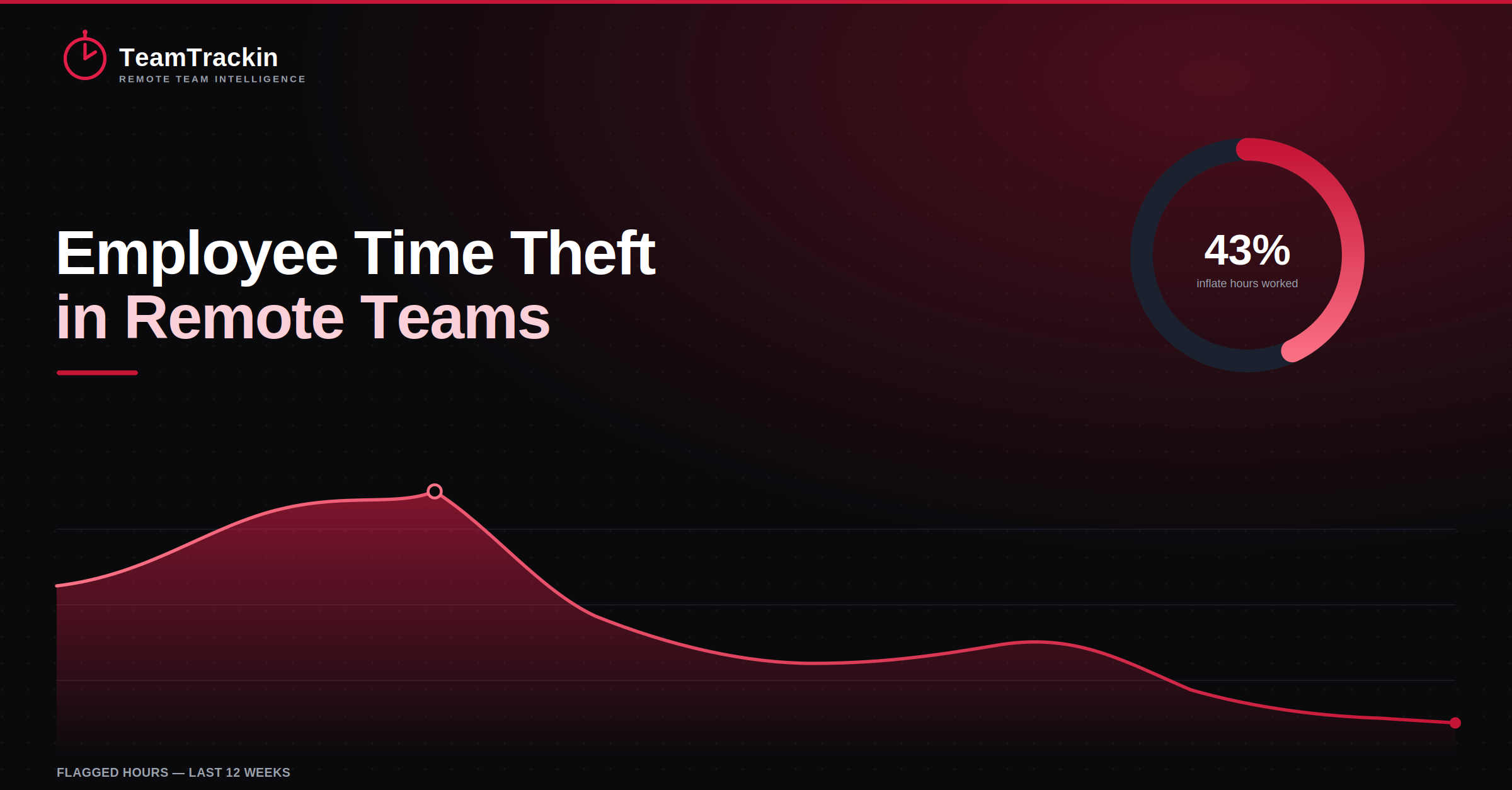
Time theft rarely looks like theft. It looks like a slightly rounded-up timesheet, a "quick errand" during clocked-in hours, or a laptop left logged in while nobody's actually working. Multiplied across a remote team with no physical oversight, it adds up fast. Here's what employee time theft actually is, why remote work makes it worse, and how to stop it without turning your workplace into a surveillance operation.
estimated annual cost of time theft to US businesses
Widely cited workplace productivity research, 2026
rise in reported time theft incidents linked to the shift to remote work
Industry workforce research, 2026
of hourly employees admit to exaggerating hours worked in anonymous surveys
American Payroll Association survey data
average reduction in time theft after implementing structured time-tracking software
Industry adoption research, 2026
What is time theft? Time theft is when an employee gets paid for hours they didn't actually work — through inflated timesheets, unlogged extended breaks, personal tasks during clocked-in time, or a coworker clocking in on their behalf. It's rarely one dramatic act; it's usually small, repeated gaps between reported time and actual work.
Employee time theft is worse in remote teams because the informal accountability of an office — a manager noticing an empty desk, a colleague seeing someone step away — simply doesn't exist. Without it, the line between "working" and "logged in but not working" blurs fast.
The fix isn't more suspicion — it's transparent time tracking software that verifies activity at the task level and gives employees visibility into their own data, so accountability replaces guesswork on both sides.
What Is Time Theft?
Employee time theft is what happens when someone is compensated for work hours they didn't actually spend working. It's a form of employee theft of time rather than money or physical goods, but the financial effect on a business is just as real — payroll goes out for labor that was never delivered.
Time theft at work is almost never a single dramatic incident. It's usually incremental: fifteen minutes rounded up here, a personal errand run during "working" hours there, a timer left running while someone steps away for an hour. None of it looks like theft in the moment. Averaged across a team over a year, it becomes one of the largest — and least discussed — sources of payroll waste most businesses carry.
Time theft is getting paid for work hours that weren't actually worked — through inflated timesheets, unlogged breaks, personal activity during clocked-in time, or someone else clocking in on an employee's behalf. It's a form of employee time clock theft that's usually gradual rather than a single deliberate act.
Why Remote Teams Are Especially Exposed
In an office, time theft has natural friction working against it — a manager walking past an empty desk, a colleague noticing a long absence, a shared sense of "everyone can see everyone." Remote work removes almost all of that friction at once.
Research has linked the broader shift toward remote work with a meaningful increase in reported time theft, with home distractions and the total absence of physical oversight cited as the leading contributors. It's not that remote employees are less honest — it's that the passive accountability structures offices provide for free simply don't exist by default in a distributed team, and most companies never replace them with anything.
The gap tends to widen with team size. A five-person remote team can often self-regulate through close daily communication. Past fifteen or twenty people, informal trust alone stops scaling, and without a structured system, small inconsistencies in reported hours become normalized across the team rather than caught early.
6 Common Forms of Employee Time Theft
Time theft takes different shapes depending on how a team works. These six are the ones that show up most often in remote and hybrid teams specifically.
Unmanaged Remote Team vs a Tracked One
The difference isn't about trust in individual employees — it's about whether the team has any system that makes accurate reporting the path of least resistance.
- Hours are self-reported with no verification of actual activity
- Managers only find out about a problem months into a pattern
- Timesheet rounding and inflation go unnoticed indefinitely
- No record to distinguish genuine overtime from unauthorized claims
- Payroll processed on trust alone, with no audit trail
- Time is logged against real tasks, with activity verification
- Unusual patterns get flagged for a quick, early conversation
- Employees see the same data managers see — no surprises
- Overtime is tied to specific, approved, logged work
- Payroll and reports are backed by a clear, exportable record
Stop time theft before it becomes a pattern.
TeamTrackin verifies activity at the task level — transparently, for every team member.
How to Stop Time Theft, Step by Step
None of this requires treating employees as suspects. It requires a system that makes honest reporting the default, rather than something people have to choose over an easier shortcut.
Rule of thumb: Most time theft isn't malicious — it's what happens by default when there's no visible system tracking the gap between reported hours and actual work. Close that gap, and most of the problem closes with it.
Catching Time Theft Without Becoming Invasive
There's a real risk in overcorrecting — turning a legitimate payroll concern into monitoring so heavy-handed it damages trust with the honest majority of the team in the process.
Verify work, not private life: Track task-level activity during working hours — not personal browsing, location outside work hours, or anything unrelated to the job itself.
- Disclosure:The team knows what's tracked and why, before it starts
- Self-access:Every employee can see their own tracked data
- Proportionality:Monitoring scope matches the actual payroll risk, not maximum surveillance
- Consistency:The same standard applies to everyone, not selectively
- Data security:Activity data is encrypted and access-controlled
TeamTrackin is built around this balance — task-level verification and configurable monitoring scope, with every employee able to see their own logged hours and reports at any time.
How TeamTrackin Helps Prevent Time Theft
Time Theft Prevention Tools Compared (2026)
| Feature | TeamTrackin | Hubstaff | Time Doctor | Toggl Track | Clockify |
|---|---|---|---|---|---|
| Idle time detection | ✓ Included | ✓ Included | ✓ Included | ~ Paid plans | ~ Paid plans |
| Anomaly / pattern alerts | ✓ Included | ~ Paid plans | ✓ Included | ✗ Not available | ✗ Not available |
| Employee self-visibility | ✓ Full access | ✓ Included | ~ Limited on lower plans | ✓ Included | ✓ Included |
| Task-level verification | ✓ Included | ✓ Included | ✓ Included | ✓ Included | ✓ Included |
| Pricing | $8 / user / mo | $9 / user / mo | $7 / user / mo | $9 / user / mo | Free – $9.99 |
Frequently Asked Questions
- What is time theft?
Time theft is when an employee is paid for hours they did not actually work — including inflating timesheets, taking extended breaks without logging them, doing personal tasks during clocked-in hours, or having a coworker clock in on their behalf. It's usually unintentional or gradual rather than deliberate fraud, but it still results in a company paying for labor it never received.
- Why is employee time theft worse in remote teams?
Remote teams lose the informal oversight that an office naturally provides, such as a manager seeing who's at their desk or colleagues noticing long absences. Without that visibility, the line between work time and personal time blurs more easily, and research has linked the shift to remote work with a meaningful rise in time theft incidents, often attributed to home distractions and the absence of any physical accountability.
- What are the most common examples of employee time clock theft?
Common examples include buddy punching (a coworker clocking in for someone who isn't actually working), rounding timesheets up in small increments, staying logged into a time tracker while doing unrelated personal activity, taking breaks that go unlogged, and claiming overtime that wasn't authorized or worked. Individually these look minor, but they compound into significant payroll losses over a year.
- How can a company reduce employee time theft without invasive monitoring?
The most effective approach combines a clear, written time policy with time tracking software that verifies activity at the task level, gives employees visibility into their own logged hours, and flags unusual patterns for review rather than recording constant surveillance footage. Transparency about what's tracked and why tends to reduce time theft on its own, since most of it happens in the absence of any visible accountability, not in spite of it.
- Does time tracking software actually reduce time theft?
Yes. Businesses that implement structured time-tracking software consistently report a measurable drop in time theft, largely because employees log hours more accurately simply knowing that time is being recorded and reviewed. The reduction tends to be larger when employees can see their own data, since the system reads as accountability rather than one-sided surveillance.